

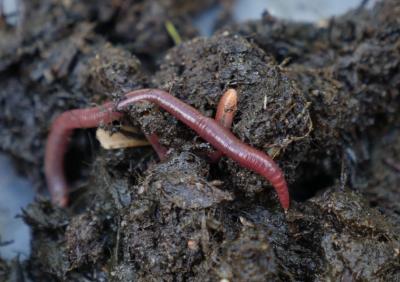
Earthworms in rich organic soil. As they burrow, the worms consume soil in order to remove nutrients from decaying organic matter such as leaves and roots. Scientists have discovered how earthworms can digest plant material, such as fallen leaves, that would defeat most other herbivores.

| Biology | August 5, 2015 04:50 AM |
| Full story | 0 Comments | 8681 views |

| Biotechnology | August 5, 2015 04:50 AM |
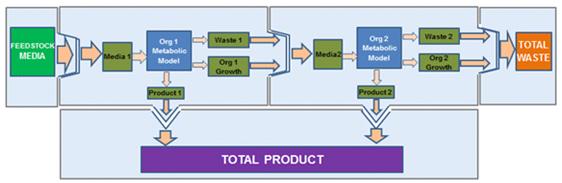
Two single computer-model modules are used by BioLEGO to characterize a two-step/two-organism fermentation process. Any two building blocks can be used, assuming they are represented in compatible model formats. The composition of feedstock biomass and the selection of fermenting microorganisms are critical factors in biorefinery design. Once biomass feedstock is identified, depending on local conditions, biorefinery designers need to select optimal fermenting organisms. Using organism communities has theoretical advantages but also leads to problems in the context of species competition, process design and modelling, in turn resulting in insufficient process control. This study presents the optimization control that is possible when using a serial fermentation approach. Using one organism after the other - in serial fermentation, rather than in a community configuration allows maximal process control, while benefiting from organism diversity to maximize feedstock conversion rates. This study introduces a freely available web-based application, BioLEGO, which provides access to computer-assisted single and two-step multiorganism fermentation process design. BioLEGO also supports the evaluation of possible biomass-to-product yields for biomass mixes or general media and recommends media changes to increase the process efficacy. BioLEGO is accessible via a simple and intuitive user interface.
| Full story | 0 Comments | 7216 views |
| Biology | August 5, 2015 04:50 AM |
A study including researchers from the U.S. Department of Energy's Argonne National Laboratory and the University of Chicago found evidence that gut microbes affect circadian rhythms and metabolism in mice.
| Full story | 0 Comments | 7378 views |

| AIDS & HIV | August 5, 2015 04:50 AM |
HIV can continue to grow in patients who are thought to be responding well to treatment, according to research by the University of Liverpool.
| Full story | 0 Comments | 7537 views |

| Molecular & Cell Biology | August 5, 2015 04:50 AM |
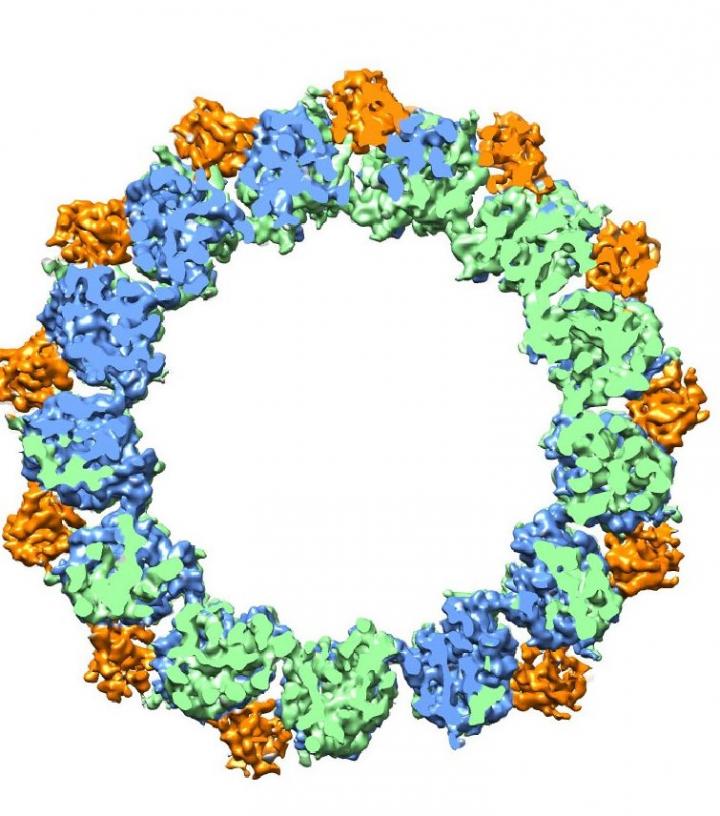
Microtubules are hollow cylinders with walls made up of tubulin proteins -- alpha (green) and beta (blue) -- plus EB proteins (orange) that can either stabilize or destabilize the structure. Microtubules, hollow fibers of tubulin protein only a few nanometers in diameter, form the cytoskeletons of living cells and play a crucial role in cell division (mitosis) through their ability to undergo rapid growth and shrinkage, a property called "dynamic instability." Through a combination of high-resolution cryo-electron microscopy (cryo-EM) and a unique methodology for image analysis, a team of researchers with Berkeley Lab and the University of California (UC) Berkeley has produced an atomic view of microtubules that enabled them to identify the crucial role played by a family of end-binding (EB) proteins in regulating microtubule dynamic instability.
| Full story | 0 Comments | 7241 views |

- In some genetic cases of microcephaly, stem cells fail to launch
- Yale team discovers how Zika virus causes fetal brain damage
- Scientists uncover the way a common cell enzyme alerts the body to invading bacteria
- Arctic gives clues on worst mass extinction of life
- Calcium channel blockers caught in the act at atomic level
Search Bio News Net
Free Biology Newsletter
- Flexibility That A.C.A. Lent to Work Force Is Threatened by...International Herald Tribune
- Bacteria Behind Legionnaires’ Disease Found at New York Police StationInternational Herald Tribune
- Prescription Price Crisis? 28 Million Americans See Spike in Drug...MSNBC.com: Health
- Seizing on Opioid Crisis, a Drug Maker Lobbies Hard for...International Herald Tribune
- Republicans are taking a big political risk on health careAP Health News
- Why We're So Divided Over Saving WolvesNational Geographic News