

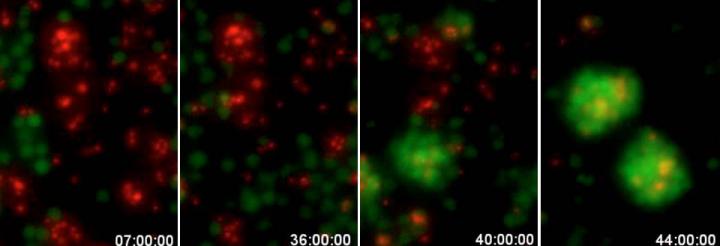
Stills from time-lapse video showing transdifferentiation of pre-B cells into yeast-eating macrophages. All it takes is one molecule to reprogram an antibody-producing B cell into a scavenging macrophage. This transformation is possible, new evidence shows, because the molecule (C/EBPa, a transcription factor) "short-circuits" the cells so that they re-express genes reserved for embryonic development. The findings appear July 30 in Stem Cell Reports, the journal of the International Society for Stem Cell Research.

| Molecular & Cell Biology | July 31, 2015 05:07 AM |
| Full story | 0 Comments | 6991 views |

| Environment | July 31, 2015 05:07 AM |
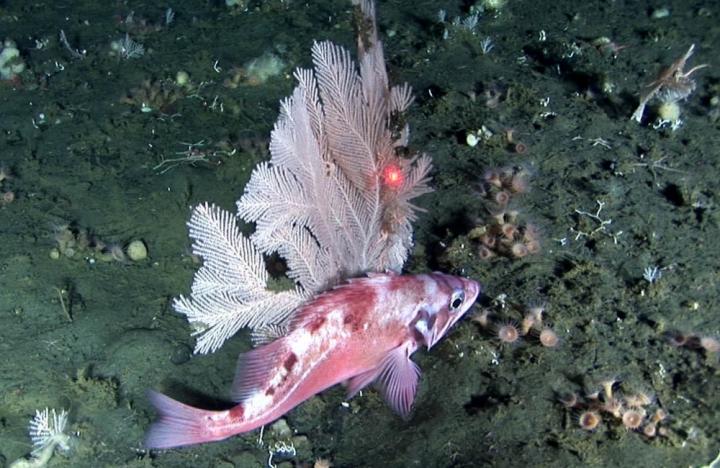
Coral habitats in the Bering Sea are home to a plethora of fish and marine mammals. North of the Aleutian Islands, submarine canyons in the cold waters of the eastern Bering Sea contain a highly productive "green belt" that is home to deep-water corals as well as a plethora of fish and marine mammals.
| Full story | 0 Comments | 7444 views |

| Biology | July 31, 2015 05:07 AM |

A golden jackal (Canis aureus) from Israel. Based on genomic results, the researchers suggest this animal, the Eurasian golden jackal, is distinct from Canis anthus Despite their remarkably similar appearance, the "golden jackals" of East Africa and Eurasia are actually two entirely different species. The discovery, based on DNA evidence and reported in the Cell Press journal Current Biology on July 30, increases the overall biodiversity of the Canidae--the group including dogs, wolves, foxes, and jackals--from 35 living species to 36.
| Full story | 0 Comments | 6917 views |

| Stem Cell Research | July 31, 2015 05:06 AM |
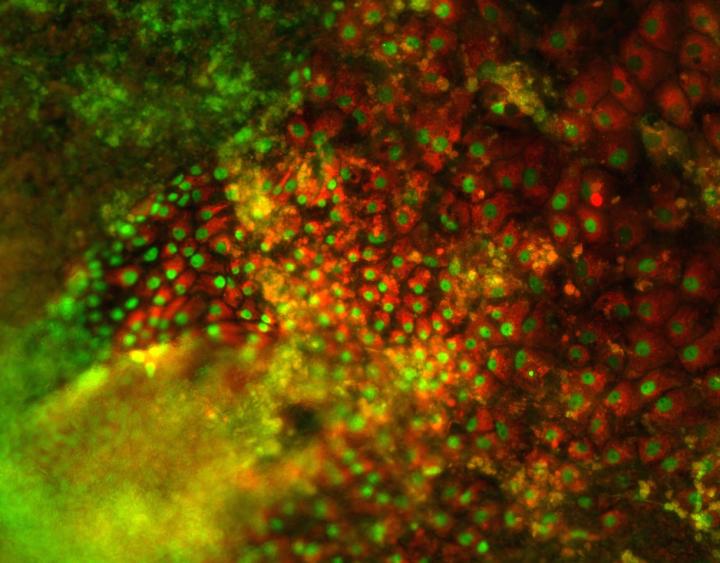
This image shows stem cell-derived hepatocytes emerging. The liver plays a critical role in human metabolism. As the gatekeeper of the digestive track, this massive organ is responsible for drug breakdown and is therefore the first to be injured due to overdose or misuse. Evaluating this drug-induced liver injury is a critical part of pharmaceutical drug discovery and must be carried out on human liver cells. Regretfully, human liver cells, called hepatocytes, are in scarce supply as they can only be isolated from donated organs.
| Full story | 0 Comments | 7358 views |

| Biotechnology | July 31, 2015 05:06 AM |
The concept of walking on water might sound supernatural, but in fact it is a quite natural phenomenon. Many small living creatures leverage water's surface tension to maneuver themselves around. One of the most complex maneuvers, jumping on water, is achieved by a species of semi-aquatic insects called water striders that not only skim along water's surface but also generate enough upward thrust with their legs to launch themselves airborne from it.
| Full story | 0 Comments | 6603 views |

| AIDS & HIV | July 31, 2015 05:06 AM |
In cells with latent HIV infection, the virus is dormant, and such cells are therefore not attacked by the immune system or by standard antiretroviral therapy. To eradicate the virus from the human body and truly cure a patient, reservoirs of latently infected cells need to be activated and eliminated "the so-called "kick-and-kill" approach. Two studies published on July 30th in PLOS Pathogens report encouraging results on the use of a combination of several drugs to efficiently reactivate HIV in cells with latent infection.
| Full story | 0 Comments | 5810 views |
| Biology | July 31, 2015 05:06 AM |
In research that could lead to protective probiotics to fight the "chytrid" fungus that has been decimating amphibian populations worldwide, Jenifer Walke, PhD, a postdoctoral researcher at Virginia Tech University, Blacksburg, and her collaborators have grown bacterial species from the skin microbiome of four species of amphibians. The research appears July 10 in Applied and Environmental Microbiology, a journal of the American Society for Microbiology.
| Full story | 0 Comments | 5536 views |

- In some genetic cases of microcephaly, stem cells fail to launch
- Yale team discovers how Zika virus causes fetal brain damage
- Scientists uncover the way a common cell enzyme alerts the body to invading bacteria
- Arctic gives clues on worst mass extinction of life
- Calcium channel blockers caught in the act at atomic level
Search Bio News Net
Free Biology Newsletter
- Flexibility That A.C.A. Lent to Work Force Is Threatened by...International Herald Tribune
- Bacteria Behind Legionnaires’ Disease Found at New York Police StationInternational Herald Tribune
- Prescription Price Crisis? 28 Million Americans See Spike in Drug...MSNBC.com: Health
- Seizing on Opioid Crisis, a Drug Maker Lobbies Hard for...International Herald Tribune
- Republicans are taking a big political risk on health careAP Health News
- Why We're So Divided Over Saving WolvesNational Geographic News