

Stem cells are especially sensitive to oxygen radicals and antioxidants shows new research from the group of Anu Wartiovaara in the Molecular Neurology Research Program of University of Helsinki. The research led by researcher Riikka Martikainen was published in Cell Reports -journal May 28th 2015.

| Health & Medicine | June 11, 2015 08:06 PM |
Pregnant women can improve their health and even reduce the risk of complications during childbirth by maintaining a healthy weight through diet and exercise. Research has shown that gaining too much weight during pregnancy increases the risk of gestational diabetes, high blood pressure, large babies, and delivery by caesarean section; and newborns with large birth weights are at risk of childhood obesity.
| Full story | 0 Comments | 6717 views |

| Molecular & Cell Biology | June 11, 2015 08:06 PM |
Researchers at the University of Toronto have uncovered how Gram-negative bacteria -- a broad class of bugs that cause diseases ranging from gonorrhea to diarrhea and pneumonia -- can trigger a reaction from our immune system. This discovery could lead to new therapies and treatments that use the immune system to fight infections instead of antibiotics.
| Full story | 0 Comments | 6484 views |
| Molecular & Cell Biology | June 11, 2015 08:06 PM |

This is a Darling Downs funnel-web spider. Its venom evolved from an insulin-like hormone. Funnel-web spider venom contains powerful neurotoxins that instantly paralyze prey (usually insects). Millions of years ago, however, this potent poison was just a hormone that helped ancestors of these spiders regulate sugar metabolism, similar to the role of insulin in humans. Surprisingly, this hormone's weaponization--described on June 11 in the journal Structure--occurred in arachnids as well as centipedes, but in different ways.
| Full story | 0 Comments | 6779 views |

| Microbiology | June 11, 2015 08:06 PM |
Researchers have identified two critical mutations allowing the deadly Middle East Respiratory Syndrome (MERS) virus to transmit from bats to humans. The findings were published in the most recent edition of the Journal of Virology.
| Full story | 0 Comments | 6055 views |

| AIDS & HIV | June 11, 2015 08:06 PM |
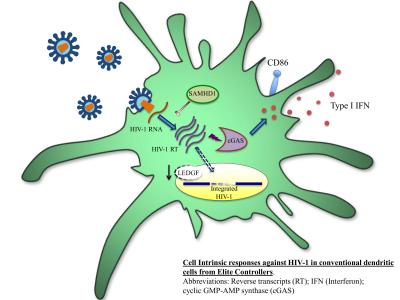
This image shows cell intrinsic responses against HIV-1 in conventional dendritic cells from Elite Controllers. Elite controllers (EC) are a small group of HIV-infected individuals who are able to suppress the virus in the absence of antiretroviral therapy. EC demonstrate that the human immune system, in principle, is capable of rendering HIV harmless. A study published on June 11th in PLOS Pathogens shows that dendritic cells (DC) of EC are supersensitive to early signs of HIV infection, and contribute to a stronger immune response than that seen in individuals who fail to control the virus in the long term.
| Full story | 0 Comments | 5899 views |

- In some genetic cases of microcephaly, stem cells fail to launch
- Yale team discovers how Zika virus causes fetal brain damage
- Scientists uncover the way a common cell enzyme alerts the body to invading bacteria
- Arctic gives clues on worst mass extinction of life
- Calcium channel blockers caught in the act at atomic level
Search Bio News Net
Free Biology Newsletter
- Flexibility That A.C.A. Lent to Work Force Is Threatened by...International Herald Tribune
- Bacteria Behind Legionnaires’ Disease Found at New York Police StationInternational Herald Tribune
- Prescription Price Crisis? 28 Million Americans See Spike in Drug...MSNBC.com: Health
- Seizing on Opioid Crisis, a Drug Maker Lobbies Hard for...International Herald Tribune
- Republicans are taking a big political risk on health careAP Health News
- Why We're So Divided Over Saving WolvesNational Geographic News