

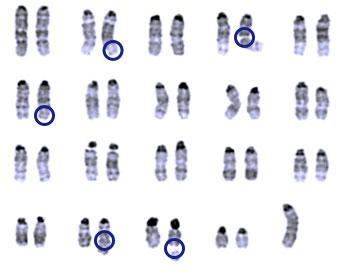
Remnants of viruses, called retrotransposons, jumped around more frequently within the genomes of cells lacking the histone variant H3.3. A family of proteins known as histones provides support and structure to DNA, but for years, scientists have been puzzling over occasional outliers among these histones, which appear to exist for specific, but often mysterious reasons. Now, researchers have uncovered a new purpose for one such histone variant: preventing genetic mutations by keeping certain so-called "jumping genes" in place.

| Molecular & Cell Biology | May 4, 2015 07:35 PM |
| Full story | 0 Comments | 5558 views |

| Biology | May 4, 2015 07:35 PM |
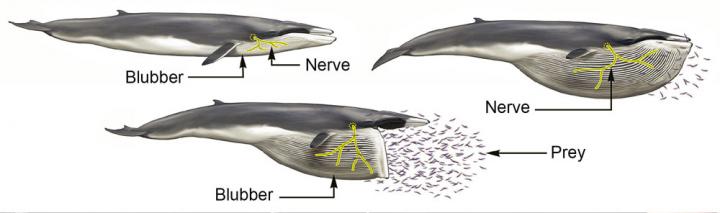
To eat, rorqual whales open their mouths and lunge while their tongues invert and their mouths fill like giant water balloons full of floating prey. Nerves aren't known for being stretchy. In fact, "nerve stretch injury" is a common form of trauma in humans. But researchers reporting in the Cell Press journal Current Biology on May 4 have discovered that nerves in the mouths and tongues of rorqual whales can more than double their length with no trouble at all.
| Full story | 0 Comments | 5752 views |

| AIDS & HIV | May 4, 2015 07:35 PM |
HIV-1 replication requires the coordinated movement of the virus's components toward the plasma membrane of an immune cell, where the virions are assembled and ultimately released. A study in The Journal of Cell Biology reveals how a Rab protein that controls intracellular trafficking supports HIV-1 assembly by promoting high levels of an important membrane lipid.
| Full story | 0 Comments | 8063 views |
| Molecular & Cell Biology | May 4, 2015 07:35 PM |
A biochemist from The University of Texas Health Science Center at San Antonio is a co-author on a paper in Nature that describes a new, more efficient method of making ribonucleic acids (RNAs).
| Full story | 0 Comments | 5243 views |
| Molecular & Cell Biology | May 4, 2015 07:35 PM |
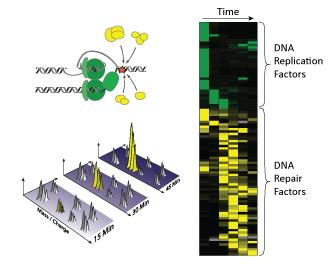
Collision of the DNA replication machinery with lesions in the DNA triggers the recruitment of a large number of DNA repair factors (yellow) that help to repair the lesions. During each cell division, more than 3.3 billion base pairs of genomic DNA have to be duplicated and segregated accurately to daughter cells. But what happens when the DNA template is damaged in such a way that the replication machinery gets stuck? To answer this question, scientists in the team of Matthias Mann at the Max Planck Institute (MPI) of Biochemistry in Martinsried near Munich, with colleagues in Copenhagen and at Harvard, have analyzed how the protein composition of the DNA replication machinery changes upon encountering damaged DNA.
| Full story | 0 Comments | 4170 views |

- In some genetic cases of microcephaly, stem cells fail to launch
- Yale team discovers how Zika virus causes fetal brain damage
- Scientists uncover the way a common cell enzyme alerts the body to invading bacteria
- Arctic gives clues on worst mass extinction of life
- Calcium channel blockers caught in the act at atomic level
Search Bio News Net
Free Biology Newsletter
- Flexibility That A.C.A. Lent to Work Force Is Threatened by...International Herald Tribune
- Bacteria Behind Legionnaires’ Disease Found at New York Police StationInternational Herald Tribune
- Prescription Price Crisis? 28 Million Americans See Spike in Drug...MSNBC.com: Health
- Seizing on Opioid Crisis, a Drug Maker Lobbies Hard for...International Herald Tribune
- Republicans are taking a big political risk on health careAP Health News
- Why We're So Divided Over Saving WolvesNational Geographic News