

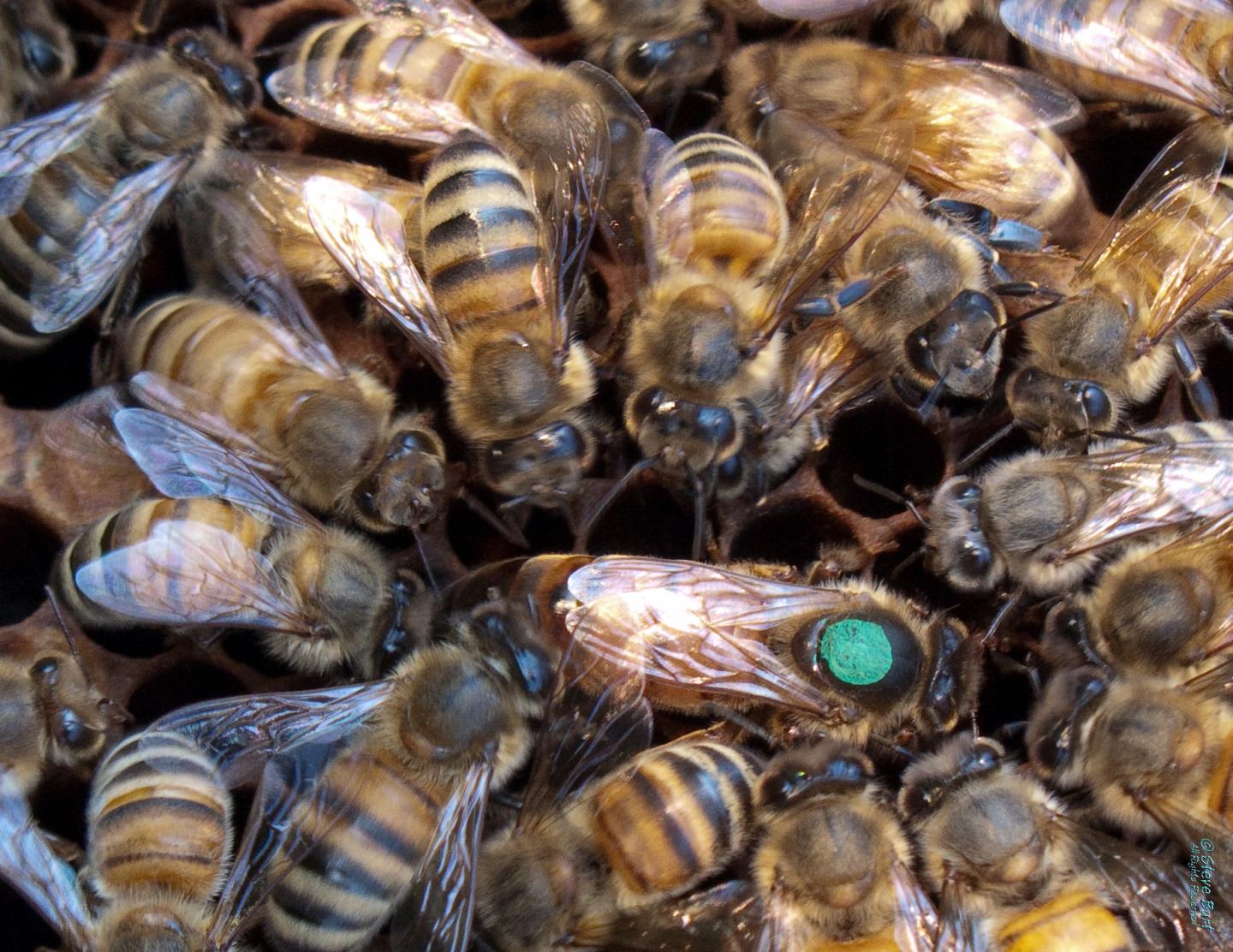
The queen bee in this image is marked with a green dot. Researchers from North Carolina State University, Indiana University and Wellesley College have characterized the gut microbiome of honey bee queens. This is the first thorough census of the gut microbiome - which consists of all the microorganisms that live in the gut of the organism - in queen bees.

| Biology | March 2, 2015 06:03 PM |
| Full story | 0 Comments | 7187 views |

| Microbiology | March 2, 2015 06:03 PM |
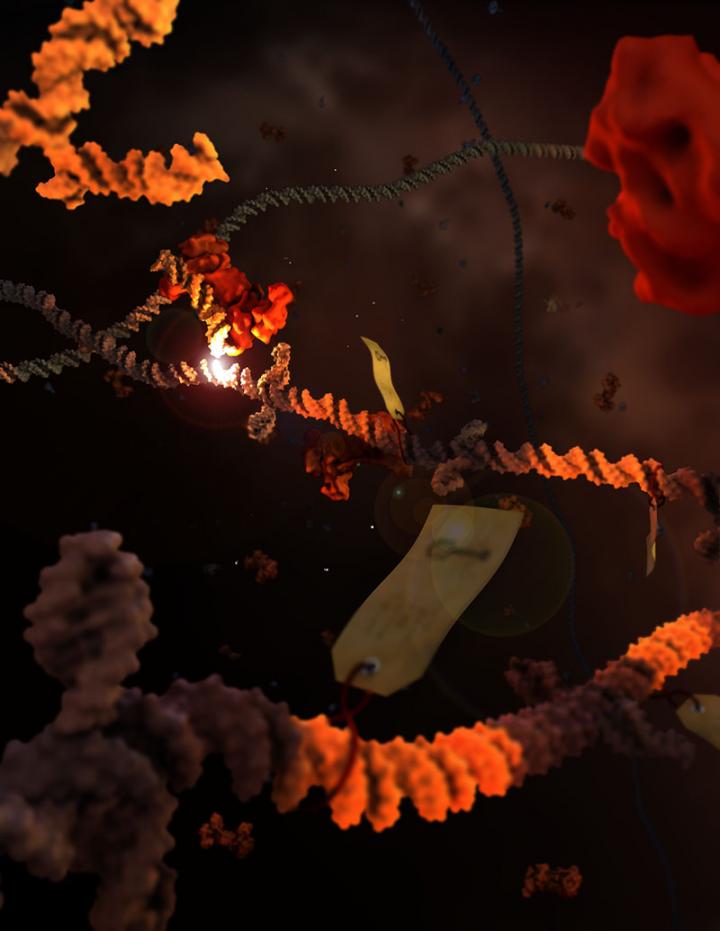
Bacteria and archaea "remember " viral infections by inserting short spacer sequences (toe-tagged) of genetic information stolen from the invader between repeat elements (gray) of the host's genomic CRISPR loci. A powerful genome editing tool may soon become even more powerful. Researchers with the Lawrence Berkeley National Laboratory (Berkeley Lab) have unlocked the key to how bacteria are able to "steal" genetic information from viruses and other foreign invaders for use in their own immunological memory system.
| Full story | 0 Comments | 6028 views |

| AIDS & HIV | March 2, 2015 06:03 PM |
Two of the four known groups of human AIDS viruses (HIV-1 groups O and P) have originated in western lowland gorillas, according to an international team of scientists from the Perelman School of Medicine at the University of Pennsylvania, the University of Montpellier, the University of Edinburgh, and others. The scientists, led by Martine Peeters from Montpellier, conducted a comprehensive survey of simian immunodeficiency virus (SIV) infection in African gorillas. Beatrice Hahn, MD, a professor of Medicine and Microbiology, and others from Penn were part of the team, whose findings appear online this week in the Proceedings of the National Academy of Sciences.
| Full story | 0 Comments | 6732 views |

| Molecular & Cell Biology | March 2, 2015 06:03 PM |
Cold Spring Harbor, NY - It sounds like the stuff of science fiction: researchers slice a brain into thin little sections and, just by measuring the properties of specific neurons, they can determine what an organism learned before it died. In fact, this sort of mind reading has become a reality. In work published today in Nature, researchers at Cold Spring Harbor Laboratory (CSHL) describe how postmortem brain slices can be "read" to determine how a rat was trained to behave in response to specific sounds. The work provides one of the first examples of how specific changes in the activity of individual neurons encode particular acts of learning and memory in the brain.
| Full story | 0 Comments | 5329 views |

- In some genetic cases of microcephaly, stem cells fail to launch
- Yale team discovers how Zika virus causes fetal brain damage
- Scientists uncover the way a common cell enzyme alerts the body to invading bacteria
- Arctic gives clues on worst mass extinction of life
- Calcium channel blockers caught in the act at atomic level
Search Bio News Net
Free Biology Newsletter
- Flexibility That A.C.A. Lent to Work Force Is Threatened by...International Herald Tribune
- Bacteria Behind Legionnaires’ Disease Found at New York Police StationInternational Herald Tribune
- Prescription Price Crisis? 28 Million Americans See Spike in Drug...MSNBC.com: Health
- Seizing on Opioid Crisis, a Drug Maker Lobbies Hard for...International Herald Tribune
- Republicans are taking a big political risk on health careAP Health News
- Why We're So Divided Over Saving WolvesNational Geographic News