

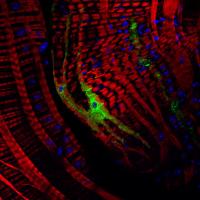
Insect muscle cells are marked in red, cell nuclei (DNA) in blue and virus in green. Insects can transmit viral diseases to humans. Therefore, understanding how insects cope with viral infection, and what immune mechanisms are triggered, can be important to stop diseases transmission. In a study published in this week's issue of the scientific journal PLOS Pathogens*, researchers from the Instituto Gulbenkian de Ciencia (IGC; Portugal) now show that the entry route of the virus changes how the insect host responds to it. Using the fruit flies as a model of study, they discovered an immune mechanism that is specifically effective when flies are infected through feeding.

| Microbiology | December 4, 2014 06:33 PM |
| Full story | 0 Comments | 11893 views |

| Molecular & Cell Biology | December 4, 2014 06:33 PM |
Cancers are due to genetic aberrations in certain cells that gain the ability to divide indefinitely. This proliferation of sick cells generates tumors, which gradually invade healthy tissue. Therefore, current therapies essentially seek to destroy cancer cells to stop their proliferation. Through high-throughput genetic sequencing of glioblastoma cells, one of the most deadly brain tumors, a team of geneticists from the University of Geneva's (UNIGE) Faculty of Medicine discovered that some of these mutations are caused by supplemental extrachromosomal DNA fragments, called double minutes, which enable cancer cells to better adapt to their environment and therefore better resist to treatments meant to destroy them. Read more in Nature Communications.
| Full story | 0 Comments | 12058 views |

| Stem Cell Research | December 4, 2014 06:33 PM |
Stem cells offer great potential in biomedical engineering due to their pluripotency, which is the ability to multiply indefinitely and also to differentiate and develop into any kind of the hundreds of different cells and bodily tissues. But the precise complexity of how stem cell development is regulated throughout states of cellular change has been difficult to pinpoint until now.
| Full story | 0 Comments | 9931 views |

- In some genetic cases of microcephaly, stem cells fail to launch
- Yale team discovers how Zika virus causes fetal brain damage
- Scientists uncover the way a common cell enzyme alerts the body to invading bacteria
- Arctic gives clues on worst mass extinction of life
- Calcium channel blockers caught in the act at atomic level
Search Bio News Net
Free Biology Newsletter
- Flexibility That A.C.A. Lent to Work Force Is Threatened by...International Herald Tribune
- Bacteria Behind Legionnaires’ Disease Found at New York Police StationInternational Herald Tribune
- Prescription Price Crisis? 28 Million Americans See Spike in Drug...MSNBC.com: Health
- Seizing on Opioid Crisis, a Drug Maker Lobbies Hard for...International Herald Tribune
- Republicans are taking a big political risk on health careAP Health News
- Why We're So Divided Over Saving WolvesNational Geographic News