

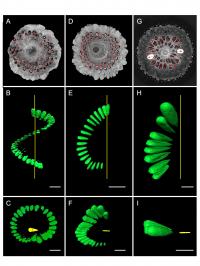
This shows fossil and recent araucarian cones sectioned in 2-D by microCT (A, D, G), and showing one segmented spiral or row of seeds By integrating high-resolution X-ray imaging (termed microCT), 3D image segmentation, and computer animation, a new study conducted by Carole Gee at the University of Bonn, Germany, demonstrates the visualization of fossils without destroying the material. Traditional techniques, such as thin-sectioning, require investigators to physically cut up the fossil in order to observe internal structures. Dr. Gee, however, has now successfully applied microCT to visualize silicified conifer seed cones as old as 150 million years without cutting, sawing, or damaging the specimens in any way.

| Biology | November 11, 2013 06:00 PM |
| Full story | 0 Comments | 6392 views |

| Bioinformatics | November 11, 2013 06:00 PM |
What does it mean to be human? According to scientists the key lies, ultimately, in the billions of lines of genetic code that comprise the human genome. The problem, however, has been deciphering that code. But now, researchers at the Gladstone Institutes have discovered how the activation of specific stretches of DNA control the development of uniquely human characteristics—and tell an intriguing story about the evolution of our species.
| Full story | 0 Comments | 6245 views |

- In some genetic cases of microcephaly, stem cells fail to launch
- Yale team discovers how Zika virus causes fetal brain damage
- Scientists uncover the way a common cell enzyme alerts the body to invading bacteria
- Arctic gives clues on worst mass extinction of life
- Calcium channel blockers caught in the act at atomic level
Search Bio News Net
Free Biology Newsletter
- Flexibility That A.C.A. Lent to Work Force Is Threatened by...International Herald Tribune
- Bacteria Behind Legionnaires’ Disease Found at New York Police StationInternational Herald Tribune
- Prescription Price Crisis? 28 Million Americans See Spike in Drug...MSNBC.com: Health
- Seizing on Opioid Crisis, a Drug Maker Lobbies Hard for...International Herald Tribune
- Republicans are taking a big political risk on health careAP Health News
- Why We're So Divided Over Saving WolvesNational Geographic News