

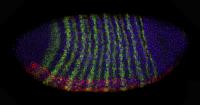
The dorsal-ventral patterning gene snail (shown in red) is one of the few genes that are active before as well as after the midblastula transition. The segmentation gene paired (shown... When egg and sperm combine, the new embryo bustles with activity. Its cells multiply so rapidly they largely ignore their DNA, other than to copy it and to read just a few essential genes. The embryonic cells mainly rely on molecular instructions placed in the egg by its mother in the form of RNA.

| Molecular & Cell Biology | August 13, 2013 07:02 PM |
| Full story | 0 Comments | 7166 views |

| Biotechnology | August 13, 2013 07:02 PM |
Ottawa researchers have developed unique virus-derived particles that can kill human blood cancer cells in the laboratory and eradicate the disease in mice with few side effects. The study is published in Blood Cancer Journal by co-senior authors Drs. David Conrad and John Bell of the Ottawa Hospital Research Institute (OHRI) and the University of Ottawa (uOttawa).
| Full story | 0 Comments | 6443 views |

| Environment | August 13, 2013 07:02 PM |
Corals can survive the early stages of their development even under the tough conditions that rising carbon emissions will impose on them says a new study from the ARC Centre of Excellence for Coral Reef Studies.
| Full story | 0 Comments | 6501 views |

| Health & Medicine | August 13, 2013 07:02 PM |
A strain of bacteria that causes skin and soft tissue infections in humans originally came from cattle, according to a study to be published in mBio®, the online open-access journal of the American Society for Microbiology. The researchers who conducted the genetic analysis of strains of Staphylococcus aureus known as CC97 say these strains developed resistance to methicillin after they crossed over into humans around forty years ago. Today, methicillin-resistant S. aureus (MRSA) strain CC97 is an emerging human pathogen in Europe, North and South America, Africa, and Asia. The findings highlight the potential for cows to serve as a reservoir for bacteria with the capacity for pandemic spread in humans.
| Full story | 0 Comments | 5835 views |

- In some genetic cases of microcephaly, stem cells fail to launch
- Yale team discovers how Zika virus causes fetal brain damage
- Scientists uncover the way a common cell enzyme alerts the body to invading bacteria
- Arctic gives clues on worst mass extinction of life
- Calcium channel blockers caught in the act at atomic level
Search Bio News Net
Free Biology Newsletter
- Flexibility That A.C.A. Lent to Work Force Is Threatened by...International Herald Tribune
- Bacteria Behind Legionnaires’ Disease Found at New York Police StationInternational Herald Tribune
- Prescription Price Crisis? 28 Million Americans See Spike in Drug...MSNBC.com: Health
- Seizing on Opioid Crisis, a Drug Maker Lobbies Hard for...International Herald Tribune
- Republicans are taking a big political risk on health careAP Health News
- Why We're So Divided Over Saving WolvesNational Geographic News