

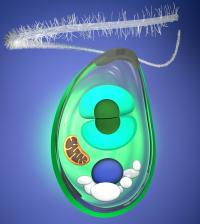
This is a schematic image of the "living fossil " Cyanophora paradoxa that is a member of the algal phylum Glaucophyta. Atmospheric oxygen really took off on our planet about 2.4 billion years ago during the Great Oxygenation Event. At this key juncture of our planet's evolution, species had either to learn to cope with this poison that was produced by photosynthesizing cyanobacteria or they went extinct. It now seems strange to think that the gas that sustains much of modern life had such a distasteful beginning.

| Bioinformatics | February 21, 2012 04:25 PM |
| Full story | 0 Comments | 14673 views |

| Molecular & Cell Biology | February 21, 2012 04:25 PM |
Johns Hopkins and National Taiwan University researchers have discovered more details about how an energy sensing "thermostat" protein determines whether cells will store or use their energy reserves.
| Full story | 0 Comments | 7645 views |

- In some genetic cases of microcephaly, stem cells fail to launch
- Yale team discovers how Zika virus causes fetal brain damage
- Scientists uncover the way a common cell enzyme alerts the body to invading bacteria
- Arctic gives clues on worst mass extinction of life
- Calcium channel blockers caught in the act at atomic level
Search Bio News Net
Free Biology Newsletter
- Flexibility That A.C.A. Lent to Work Force Is Threatened by...International Herald Tribune
- Bacteria Behind Legionnaires’ Disease Found at New York Police StationInternational Herald Tribune
- Prescription Price Crisis? 28 Million Americans See Spike in Drug...MSNBC.com: Health
- Seizing on Opioid Crisis, a Drug Maker Lobbies Hard for...International Herald Tribune
- Republicans are taking a big political risk on health careAP Health News
- Why We're So Divided Over Saving WolvesNational Geographic News