

As planktonic organisms the larvae of the marine annelid Platynereis swim freely in the open water. They move by activity of their cilia, thousands of tiny hair-like structures forming a band along the larval body and beating coordinately. With changing environmental conditions the larvae swim upward and downward to their appropriate water depth. Scientists of the Max Planck Institute for Developmental Biology in Tübingen, Germany have now identified some signalling substances in the larval nervous system regulating swimming depth of the larvae. These substances influence the ciliary beating and thus hold the larvae in the preferred water depth. The scientists discovered a very simple circuitry of nerve cells underlying this regulation, reflecting an early evolutionary state of the nervous system.

| Biotechnology | October 18, 2011 04:48 PM |
Scientists have successfully demonstrated that they can build some of the basic components for digital devices out of bacteria and DNA, which could pave the way for a new generation of biological computing devices, in research published today in the journal Nature Communications.
| Full story | 0 Comments | 9617 views |

| Molecular & Cell Biology | October 18, 2011 04:48 PM |
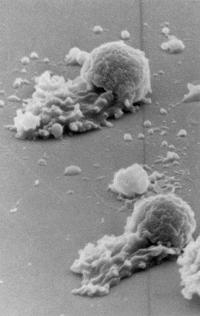
This is an electron microscope image of two crawling worm sperm magnified ~5,000X. For better and for worse, human health depends on a cell's motility –– the ability to crawl from place to place. In every human body, millions of cells –are crawling around doing mostly good deeds ––– though if any of those crawlers are cancerous, watch out.
| Full story | 0 Comments | 13129 views |

- In some genetic cases of microcephaly, stem cells fail to launch
- Yale team discovers how Zika virus causes fetal brain damage
- Scientists uncover the way a common cell enzyme alerts the body to invading bacteria
- Arctic gives clues on worst mass extinction of life
- Calcium channel blockers caught in the act at atomic level
Search Bio News Net
Free Biology Newsletter
- Flexibility That A.C.A. Lent to Work Force Is Threatened by...International Herald Tribune
- Bacteria Behind Legionnaires’ Disease Found at New York Police StationInternational Herald Tribune
- Prescription Price Crisis? 28 Million Americans See Spike in Drug...MSNBC.com: Health
- Seizing on Opioid Crisis, a Drug Maker Lobbies Hard for...International Herald Tribune
- Republicans are taking a big political risk on health careAP Health News
- Why We're So Divided Over Saving WolvesNational Geographic News