

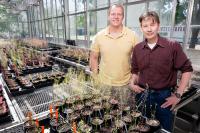
University of Illinois animal biology professor and department head Ken Paige (right) and doctoral student Daniel Scholes discovered that some plants multiply their chromosomes without undergoing cell division Whatever does not kill a plant may actually make it stronger. After being partially eaten by grazing animals, for example, some plants grow bigger and faster and reproduce more successfully than they otherwise would. In a new study, researchers report that one secret to these plants' post-traumatic triumph lies in their ability to duplicate their chromosomes – again and again – without undergoing cell division.

| Biology | August 1, 2011 11:41 PM |
| Full story | 0 Comments | 7833 views |

| Bioinformatics | August 1, 2011 11:41 PM |
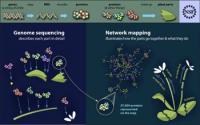
Proteins are essential components of Arabidopsis parts, such as petals, stalks and flowers. The genetics of these essential proteins were previously identified through studies involving genome sequencing. An international consortium of scientists has produced the first systematic network map of interactions that occur between proteins in the plant Arabidopsis thaliana. (Arabidopsis is a mustard plant that has 27,000 proteins and serves as a popular model organism for biological studies of plants, analogous to lab rats that serve as popular model organisms for biological studies of animals.)
| Full story | 0 Comments | 7833 views |

- In some genetic cases of microcephaly, stem cells fail to launch
- Yale team discovers how Zika virus causes fetal brain damage
- Scientists uncover the way a common cell enzyme alerts the body to invading bacteria
- Arctic gives clues on worst mass extinction of life
- Calcium channel blockers caught in the act at atomic level
Search Bio News Net
Free Biology Newsletter
- Flexibility That A.C.A. Lent to Work Force Is Threatened by...International Herald Tribune
- Bacteria Behind Legionnaires’ Disease Found at New York Police StationInternational Herald Tribune
- Prescription Price Crisis? 28 Million Americans See Spike in Drug...MSNBC.com: Health
- Seizing on Opioid Crisis, a Drug Maker Lobbies Hard for...International Herald Tribune
- Republicans are taking a big political risk on health careAP Health News
- Why We're So Divided Over Saving WolvesNational Geographic News