

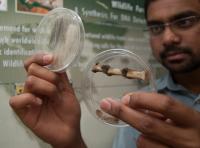
Ph.D. candidate Ashwin Naidu in the School of Natural Resources and the Environment works in the conservation genetics lab to identify individual animals or species from DNA evidence. Wildlife face many threats with spreading urbanization, including habitat loss and inbreeding when populations become fragmented and isolated. It doesn't help that there is a billion-dollar international industry dedicated to the illegal trafficking of wild animals or wild animal parts.

| Biology | June 9, 2011 10:56 AM |
| Full story | 0 Comments | 10592 views |

| Biotechnology | June 9, 2011 10:56 AM |
A team of scientists has developed a way to coax tumor cells in the lab to grow into 3-D spheres. Their discovery takes advantage of an earlier technique of producing spherical cavities in a common polymer and promises more accurate tests of new cancer therapies.
| Full story | 0 Comments | 6952 views |

| Molecular & Cell Biology | June 9, 2011 10:56 AM |
Body cells detect signals that control their behavior through tiny hairs on the cell surface called cilia. Serious diseases and disorders can result when these cilia do not work properly. New research from UC Davis published this week in the journal Nature Cell Biology provides new insights into how these cilia are assembled.
| Full story | 0 Comments | 8150 views |

| Health & Medicine | June 9, 2011 10:56 AM |
The swine flu outbreak of winter 2009-2010 was much more widespread than was previously realised, research suggests.
| Full story | 0 Comments | 6833 views |
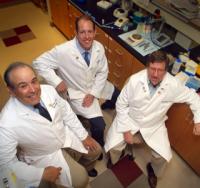
The right nutrients resulting in the right signals could help aging stem cells act more youthful, producing stronger bones longer and reducing the death and disability associated with a frail framework, Georgia Health Sciences University researchers say. from left Drs. Carlos Isales, Mark W. Hamrick and William D. Hill Researchers want to turn back the clock on aging stem cells so they'll make better bone.
| Full story | 0 Comments | 5940 views |
| Biology | June 9, 2011 10:56 AM |
Gazing into the depths of a pond, it's hard to miss the insects that whirl and zip beneath the surface. However, only one species of spider has joined them: the diving bell spider, Argyroneta aquatica. 'It is an iconic animal; I had read about the spider as a small boy in popular literature about ponds,' says Roger Seymour from the University of Adelaide. According to Seymour, each spider constructs a net of silk in vegetation beneath the surface and fills it with air carried down on its abdomen. The spiders spend their entire lives submerged and even lay their eggs in their diving bells. Having already used an oxygen-measuring device called an optode to discover how aquatic insects extract oxygen from water through thin bubbles of air stretched across their abdomens, Seymour was looking for other small bubbles to test his optode. 'The famous water spider came to mind,' remembers Seymour, and when he mentioned the possibility to Stefan Hetz from Humboldt University, Germany, Hetz jumped at the idea. Inviting Seymour to his lab, the duo decided to collect some of the arachnids to find out how they use their diving bells. The duo report their discovery that the spiders can use the diving bell like a gill to extract oxygen from water to remain hidden beneath the surface in The Journal of Experimental Biology at http://jeb.biologists.org/content/214/13/2175.abstract
| Full story | 0 Comments | 6551 views |

- In some genetic cases of microcephaly, stem cells fail to launch
- Yale team discovers how Zika virus causes fetal brain damage
- Scientists uncover the way a common cell enzyme alerts the body to invading bacteria
- Arctic gives clues on worst mass extinction of life
- Calcium channel blockers caught in the act at atomic level
Search Bio News Net
Free Biology Newsletter
- Flexibility That A.C.A. Lent to Work Force Is Threatened by...International Herald Tribune
- Bacteria Behind Legionnaires’ Disease Found at New York Police StationInternational Herald Tribune
- Prescription Price Crisis? 28 Million Americans See Spike in Drug...MSNBC.com: Health
- Seizing on Opioid Crisis, a Drug Maker Lobbies Hard for...International Herald Tribune
- Republicans are taking a big political risk on health careAP Health News
- Why We're So Divided Over Saving WolvesNational Geographic News