

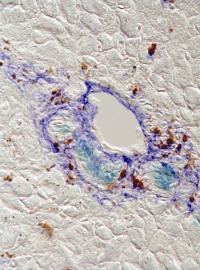
Liver stem cells expressing FoxL1 (aqua blue) in an injured mouse liver near the bile duct. The FoxL1-containing stem cells are encircled by liver fibroblasts (royal blue), suggestive of a stem cell niche. Credit: Linda Greenbaum, M.D., University of Pennsylvania School of Medicine

| Stem Cell Research | November 12, 2008 10:20 PM |
| Full story | 0 Comments | 13568 views |

| Biology | November 12, 2008 10:20 PM |
Brain cells can adopt a new chemical code in response to cues from the outside world, scientists working with tadpoles at the University of California, San Diego report in the journal Nature this week.
| Full story | 0 Comments | 8816 views |

| Health & Medicine | November 12, 2008 11:57 AM |
A high proportion of people are not using condoms when they have sex with a new partner, according to a new study of heterosexual partnerships among British men and women. Among people in their 30s and 40s, and in partnerships where there is an age difference of five or more years, condom use is particularly low.
| Full story | 0 Comments | 6165 views |

| Molecular & Cell Biology | November 12, 2008 11:57 AM |
Researchers at the University of Delaware have provided what is believed to be the first experimental evidence that plants can take up nanoparticles and accumulate them in their tissues
| Full story | 0 Comments | 5333 views |

| Bioinformatics | November 12, 2008 11:57 AM |
Increased use of computers to create predictive models of human disease is likely following a workshop organised by the European Science Foundation (ESF), which urged for a collaborative effort between specialists in the field. Human disease research produces an enormous amount of data from different sources such as animal models, high throughput genetic screening of human tissue, and in vitro laboratory experiments. This data operates at different levels and scales including genes, molecules, cells, tissues and whole organs, embodying a huge amount of potentially valuable insight that current computer modelling approaches often fail to exploit properly.
| Full story | 0 Comments | 6121 views |

- In some genetic cases of microcephaly, stem cells fail to launch
- Yale team discovers how Zika virus causes fetal brain damage
- Scientists uncover the way a common cell enzyme alerts the body to invading bacteria
- Arctic gives clues on worst mass extinction of life
- Calcium channel blockers caught in the act at atomic level
Search Bio News Net
Free Biology Newsletter
- Flexibility That A.C.A. Lent to Work Force Is Threatened by...International Herald Tribune
- Bacteria Behind Legionnaires’ Disease Found at New York Police StationInternational Herald Tribune
- Prescription Price Crisis? 28 Million Americans See Spike in Drug...MSNBC.com: Health
- Seizing on Opioid Crisis, a Drug Maker Lobbies Hard for...International Herald Tribune
- Republicans are taking a big political risk on health careAP Health News
- Why We're So Divided Over Saving WolvesNational Geographic News