

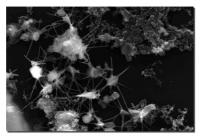
Needle-like particles containing lead, zinc, and chlorine were among the several forms of metallic particles collected at the T0 site during the MILAGRO Campaign. A new report by scientists who are part of the international MILAGRO Campaign indicates that some of the most harmful air pollution in Mexico City may not come from motor vehicles but instead originates with industrial sources – and that the culprit may be garbage incineration.

| Health & Medicine | September 8, 2008 03:39 PM |
| Full story | 0 Comments | 6024 views |

| Biology | September 8, 2008 03:39 PM |
What makes a memory? Single cells in the brain, for one thing. For the first time, scientists at UCLA and the Weizmann Institute of Science in Israel have recorded individual brain cells in the act of calling up a memory, thus revealing where in the brain a specific memory is stored, and how it is able to recreate it.
| Full story | 0 Comments | 10825 views |
| Biology | September 8, 2008 03:39 PM |
The McClellan Nuclear Radiation Center (MNRC) in Sacramento, CA was developed by the U.S. Air Force to detect corrosion and defects in aircraft structure using an imaging technique called neutron radiography. This technique is currently helping soil scientists understand the function of plant roots and their uptake of water and nutrients.
| Full story | 0 Comments | 5332 views |

| Molecular & Cell Biology | September 8, 2008 03:39 PM |
The protein IKKalpha (IKKα) regulates the cell cycle of keratinocytes and plays a key role in keeping these specialized skin cells from becoming malignant, researchers at The University of Texas M. D. Anderson Cancer Center report in the Sept. 9 issue of Cancer Cell.
| Full story | 0 Comments | 7324 views |
| Biology | September 8, 2008 03:39 PM |
The probability of someone cheating during the course of a relationship varies between 40 and 76 percent. "It's very high," says Geneviève Beaulieu-Pelletier, PhD student at the Université de Montréal's Department of Psychology.
| Full story | 0 Comments | 7265 views |

| Microbiology | September 8, 2008 03:39 PM |
A new paper by a team of researchers led by Shahriar Mobashery, Navari Family Professor of Life Sciences at the University of Notre Dame, provides important new insights into the process by which bacteria recycle their cell wall.
| Full story | 0 Comments | 6726 views |
| Health & Medicine | September 8, 2008 03:39 PM |
Children born prematurely are four times more likely to have emotional problems or behavioural disorders, according to research led by the University of Warwick.
| Full story | 0 Comments | 6306 views |

- In some genetic cases of microcephaly, stem cells fail to launch
- Yale team discovers how Zika virus causes fetal brain damage
- Scientists uncover the way a common cell enzyme alerts the body to invading bacteria
- Arctic gives clues on worst mass extinction of life
- Calcium channel blockers caught in the act at atomic level
Search Bio News Net
Free Biology Newsletter
- Flexibility That A.C.A. Lent to Work Force Is Threatened by...International Herald Tribune
- Bacteria Behind Legionnaires’ Disease Found at New York Police StationInternational Herald Tribune
- Prescription Price Crisis? 28 Million Americans See Spike in Drug...MSNBC.com: Health
- Seizing on Opioid Crisis, a Drug Maker Lobbies Hard for...International Herald Tribune
- Republicans are taking a big political risk on health careAP Health News
- Why We're So Divided Over Saving WolvesNational Geographic News