


Even scientists define 'a gene' in different ways, so it comes as little surprise that the media also have various ways of framing the concept of a gene, according to a new study appearing in the October 2008 issue of EMBO reports.

| Health & Medicine | September 5, 2008 12:19 PM |
Free drug samples provided to physicians by pharmaceutical companies could actually be costing uninsured patients more in the long run, according to a study done by researchers at Wake Forest University Baptist Medical Center and colleagues.
| Full story | 0 Comments | 5468 views |

| Biology | September 5, 2008 12:19 PM |
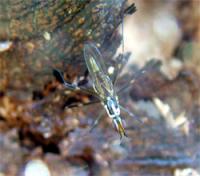
A marked T. angusticollis female on an Acacia trunk in Sydney. Evolutionary studies of aging typically utilize small, short-lived animals (insects, worms, mice) under benign conditions – constant temperature and humidity, no parasites, superabundant food – in the laboratory. Oddly enough, very little is known about aging in such animals in their harsh, stressful natural environments. Could it be that these laboratory "guinea pigs" actually age much more slowly in captive luxury than do their wild cousins?
| Full story | 0 Comments | 5378 views |
| Biology | September 5, 2008 12:19 PM |

Photos taken in Pakistan. Captive breeding colonies of a critically endangered vulture, whose numbers in the wild have dwindled from tens of millions to a few thousand, are too small to protect the species from extinction, a University of Michigan analysis shows.
| Full story | 0 Comments | 6891 views |

| AIDS & HIV | September 5, 2008 12:19 PM |
Mammalian fatty acid synthase is one of the most complex molecular synthetic machines in human cells. It is also a promising target for the development of anti-cancer and anti-obesity drugs and the treatment of metabolic disorders. Now researchers at ETH Zurich have determined the atomic structure of a mammalian fatty acid synthase. Their results have just been published in Science magazine.
| Full story | 0 Comments | 8341 views |

- In some genetic cases of microcephaly, stem cells fail to launch
- Yale team discovers how Zika virus causes fetal brain damage
- Scientists uncover the way a common cell enzyme alerts the body to invading bacteria
- Arctic gives clues on worst mass extinction of life
- Calcium channel blockers caught in the act at atomic level
Search Bio News Net
Free Biology Newsletter
- Flexibility That A.C.A. Lent to Work Force Is Threatened by...International Herald Tribune
- Bacteria Behind Legionnaires’ Disease Found at New York Police StationInternational Herald Tribune
- Prescription Price Crisis? 28 Million Americans See Spike in Drug...MSNBC.com: Health
- Seizing on Opioid Crisis, a Drug Maker Lobbies Hard for...International Herald Tribune
- Republicans are taking a big political risk on health careAP Health News
- Why We're So Divided Over Saving WolvesNational Geographic News