

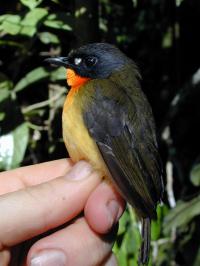
A male specimen of the newly-discovered olive-backed forest robin is carefully examined in the hand of Brian Schmidt, the Smithsonian ornithologist who discovered the species. Scientists at the Smithsonian Institution have discovered a new species of bird in Gabon, Africa, that was, until now, unknown to the scientific community. Their findings were published in the international science journal Zootaxa today, Aug. 15.

| Biology | August 16, 2008 08:58 PM |
| Full story | 0 Comments | 7814 views |
| Biology | August 16, 2008 08:58 PM |
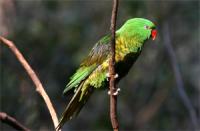
Parrots have a big brain and are also one of the most evolutionarily diversified bird clades. Ever since Darwin, evolutionary biologists have wondered why some lineages have diversified more than others. A classical explanation is that a higher rate of diversification reflects increased ecological opportunities that led to a rapid adaptive radiation of a clade. A textbook example is Darwin finches from Galapagos, whose ancestor colonized a competitors-free archipelago and rapidly radiated in 13 species, each one adapted to use the food resources in a different way. This and other examples have led some to think that the progenitors of the major evolutionary radiations are those that happened to be in the right place and at the right time to take advantage of ecological opportunities. However, is it possible that biological diversification not only depends on the properties of the environment an ancestral species finds itself in, but also on the features of the species itself? Now a study supports this possibility, suggesting that possessing a large brain might have facilitated the evolutionary diversification of some avian lineages.
| Full story | 0 Comments | 11733 views |

| Biotechnology | August 16, 2008 08:58 PM |
Michigan State University scientists, armed with a half-million-dollar federal grant, are creating an easily accessible, Web-based genomic database of information on crops that can be used to make ethanol.
| Full story | 0 Comments | 6582 views |

| Molecular & Cell Biology | August 16, 2008 08:58 PM |
When a cell begins to multiply in a dangerously abnormal way, a series of death signals trigger it to self-destruct before it turns cancerous. Now, in research to appear in the August 15 issue of Genes & Development, Rockefeller University scientists have figured out a way in mice to amplify the signals that tell these precancerous cells to die. The trick: Inactivating a protein that normally helps cells to avoid self-destruction.
| Full story | 0 Comments | 6881 views |
| Biotechnology | August 16, 2008 08:58 PM |
Researchers at the California Institute of Technology have developed a novel way to churn out large quantities of drugs, including antiplaque toothpaste additives, antibiotics, nicotine, and even morphine, using mini biofactories--in yeast.
| Full story | 0 Comments | 6252 views |

- In some genetic cases of microcephaly, stem cells fail to launch
- Yale team discovers how Zika virus causes fetal brain damage
- Scientists uncover the way a common cell enzyme alerts the body to invading bacteria
- Arctic gives clues on worst mass extinction of life
- Calcium channel blockers caught in the act at atomic level
Search Bio News Net
Free Biology Newsletter
- Flexibility That A.C.A. Lent to Work Force Is Threatened by...International Herald Tribune
- Bacteria Behind Legionnaires’ Disease Found at New York Police StationInternational Herald Tribune
- Prescription Price Crisis? 28 Million Americans See Spike in Drug...MSNBC.com: Health
- Seizing on Opioid Crisis, a Drug Maker Lobbies Hard for...International Herald Tribune
- Republicans are taking a big political risk on health careAP Health News
- Why We're So Divided Over Saving WolvesNational Geographic News