

A new ecological study led by a University of Adelaide researcher should help identify species prone to extinction under environmental change, and species that are likely to become a pest.

| Health & Medicine | June 13, 2008 12:23 PM |
A synthetic chemical based on a compound found in cocoa beans slowed growth and accelerated destruction of human tumors in laboratory studies, and should be tested further for cancer chemoprevention or even treatment, say researchers at Georgetown University Medical Center.
| Full story | 0 Comments | 7044 views |

| Environment | June 13, 2008 12:23 PM |
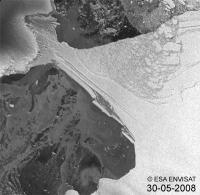
Wilkins Ice Shelf has experienced further break-up with an area of about 160 square kilometers breaking off. This animation, comprised of images acquired by Envisat's Advanced Synthetic Aperture Radar between May 30 and June 9, 2008, highlights the rapidly dwindling strip of ice that is protecting thousands of kilometers of the ice shelf from further break-up. This is the first ever-documented episode to occur in winter. Credit: ESA Wilkins Ice Shelf has experienced further break-up with an area of about 160 km² breaking off from 30 May to 31 May 2008. ESA's Envisat satellite captured the event – the first ever-documented episode to occur in winter.
| Full story | 0 Comments | 6154 views |

| Microbiology | June 13, 2008 12:23 PM |
Salmonella is serving up a surprise not only for tomato lovers around the country but also for scientists who study the rod-shaped bacterium that causes misery for millions of people.
| Full story | 0 Comments | 9108 views |

| Biology | June 13, 2008 12:23 PM |
Why bother running on hind legs when the four you've been given work perfectly well? This is the question that puzzles Christofer Clemente. For birds and primates, there's a perfectly good answer: birds have converted their forelimbs into wings, and primates have better things to do with their hands. But why have some lizards gone bipedal? Have they evolved to trot on two feet, or is their upright posture simply a fluke of physics? Curious to find the answer, Clemente and his colleagues Philip Withers, Graham Thompson and David Lloyd decided to test how dragon lizards run on two legs.
| Full story | 0 Comments | 7725 views |
| Health & Medicine | June 13, 2008 12:23 PM |
UT Southwestern Medical Center surgeons have completed the first single-incision Lap-Band weight-loss surgery in Texas.
| Full story | 0 Comments | 7893 views |

| Molecular & Cell Biology | June 13, 2008 12:23 PM |
Scientists funded by the Biotechnology and Biological Sciences Research Council (BBSRC) have discovered how evolution may have lumbered humans with allergy problems. The team from the Randall Division of Cell & Molecular Biophysics, King's College London are working on a molecule vital to a chicken's immune system which represents the evolutionary ancestor of the human antibodies that cause allergic reactions. Crucially, they have discovered that the chicken molecule behaves quite differently from its human counterpart, which throws light on the origin and cause of allergic reactions in humans and gives hope for new strategies for treatment. The work is published today (13 June) in The Journal of Biological Chemistry.
| Full story | 0 Comments | 6493 views |

- In some genetic cases of microcephaly, stem cells fail to launch
- Yale team discovers how Zika virus causes fetal brain damage
- Scientists uncover the way a common cell enzyme alerts the body to invading bacteria
- Arctic gives clues on worst mass extinction of life
- Calcium channel blockers caught in the act at atomic level
Search Bio News Net
Free Biology Newsletter
- Flexibility That A.C.A. Lent to Work Force Is Threatened by...International Herald Tribune
- Bacteria Behind Legionnaires’ Disease Found at New York Police StationInternational Herald Tribune
- Prescription Price Crisis? 28 Million Americans See Spike in Drug...MSNBC.com: Health
- Seizing on Opioid Crisis, a Drug Maker Lobbies Hard for...International Herald Tribune
- Republicans are taking a big political risk on health careAP Health News
- Why We're So Divided Over Saving WolvesNational Geographic News