


Yellowstone pronghorn populations directly benefit from the presence of wolves, a new Wildlife Conservation Society study says. As western states debate removing the gray wolf from protection under the Endangered Species Act, a new study by the Wildlife Conservation Society cautions that doing so may result in an unintended decline in another species: the pronghorn, a uniquely North American animal that resembles an African antelope.

| Biology | March 3, 2008 11:59 PM |
| Full story | 0 Comments | 7546 views |

| Environment | March 3, 2008 10:59 PM |
NOAA scientists are reviewing unusual environmental conditions in the Pacific Ocean as the likely culprit for the dramatically low returns of Chinook and coho salmon to rivers and streams along the West Coast of the United States in 2007.
| Full story | 0 Comments | 6855 views |
| Biology | March 3, 2008 09:59 PM |
Although researchers have long agreed that girls have superior language abilities than boys, until now no one has clearly provided a biological basis that may account for their differences.
| Full story | 0 Comments | 9045 views |
| Biology | March 3, 2008 08:59 PM |
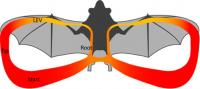
A simplified representation of the strong vortices associated with the unsteady aerodynamics of bat flight at slow speeds. The vortices can be thought of as causing the surrounding air to rotate rapidly around them and this motion around the LEV on top of the wing increases the lift force on it. Just like familiar, fixed-wing planes, the bat also leaves tip vortices in its wake, but the overall flow is further modified by the start vortices created at the beginning of the downstroke. Credit: USC-generated schematic Honey bees and hummingbirds can hover like helicopters for minutes at a time, sucking the juice from their favorite blossoms while staying aloft in a swirl of vortices.
| Full story | 0 Comments | 7393 views |

| Stem Cell Research | March 3, 2008 07:59 PM |
A toxic pollutant spread by oil spills, forest fires and car exhaust is also present in cigarette smoke, and may represent a second way in which smoking delays bone healing, according to research presented today at the annual meeting of the Orthopaedic Research Society in San Francisco.
| Full story | 0 Comments | 8592 views |

| AIDS & HIV | March 3, 2008 06:59 PM |
A Canada-U.S. research team has solved a major genetic mystery: How a protein in some people’s DNA guards them against killer immune diseases such as HIV. In an advance online edition of Nature Medicine, the scientists explain how the protein, FOX03a, shields against viral attacks and how the discovery will help in the development of a HIV vaccine.
| Full story | 0 Comments | 7029 views |
| Biology | March 3, 2008 05:59 PM |
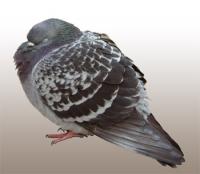
A pigeon taking a little nap. In humans, as in all mammals, sleep consists of two phases: deep, dreamless slow-wave-sleep (SWS) alternates with dream phases, called Rapid Eye Movement (REM)-sleep. Although several studies suggest that information is processed and memories are consolidated during sleep, this remains a hotly debated topic in neurobiology. Comparative studies in birds may help to clarify the function of sleep by revealing overriding principles that would otherwise remain obscure if we only studied mammals. This is because birds are the only taxonomic group other than mammals to show both SWS and REM sleep. Interestingly, the independent evolution of similar sleep states in birds and mammals might be related to the fact that each group also independently evolved large brains capable of performing complex cognitive processes. In their actual study, researchers from the Max-Planck Institute of Ornithology in Seewiesen, Germany showed for the first time that birds compensate for sleep loss in a manner similar to humans (Journal of Sleep Research, Online-Publication February 27, 2008).
| Full story | 0 Comments | 7073 views |

| Molecular & Cell Biology | March 3, 2008 04:59 PM |
Two cell proteins that relax the gut and help accommodate a big meal have been identified by UCL (University College London) scientists. The proteins could offer a future drug target against weight gain, by preventing the stomach from expanding.
| Full story | 0 Comments | 6128 views |

- In some genetic cases of microcephaly, stem cells fail to launch
- Yale team discovers how Zika virus causes fetal brain damage
- Scientists uncover the way a common cell enzyme alerts the body to invading bacteria
- Arctic gives clues on worst mass extinction of life
- Calcium channel blockers caught in the act at atomic level
Search Bio News Net
Free Biology Newsletter
- Flexibility That A.C.A. Lent to Work Force Is Threatened by...International Herald Tribune
- Bacteria Behind Legionnaires’ Disease Found at New York Police StationInternational Herald Tribune
- Prescription Price Crisis? 28 Million Americans See Spike in Drug...MSNBC.com: Health
- Seizing on Opioid Crisis, a Drug Maker Lobbies Hard for...International Herald Tribune
- Republicans are taking a big political risk on health careAP Health News
- Why We're So Divided Over Saving WolvesNational Geographic News