

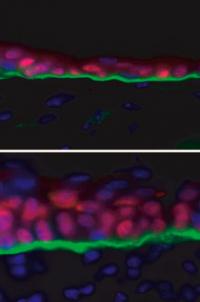
In the outer layer of the skin, microRNA-203 helps build a tough protective barrier by repressing the activity of a molecule called p63 (red). When microRNA-203 can't stem p63's activity, cells proliferate (bottom) -- findings that may reveal new insights about cancer. Credit: The Rockefeller University Every minute, 30,000 of our outermost skin cells die so that we can live. When they do, new cells migrate from the inner layer of the skin to the surface of it, where they form a tough protective barrier. In a series of elegant experiments in mice, researchers at Rockefeller University have now discovered a tiny RNA molecule that helps create this barrier. The results not only yield new insight into how skin first evolved, but also suggest how healthy cells can turn cancerous.

| Molecular & Cell Biology | March 2, 2008 01:34 PM |
| Full story | 0 Comments | 10198 views |
| Molecular & Cell Biology | March 2, 2008 01:34 PM |
Researchers at the University of Southern California (USC) have uncovered a new way to develop more effective tumor vaccines by turning off the suppression function of regulatory T cells. The results of the study, titled “A20 is an antigen presentation attenuator, and its inhibition overcomes regulatory T cell-mediated suppression,” will be published in Nature Medicine on March 2, 2008.
| Full story | 0 Comments | 8221 views |

- In some genetic cases of microcephaly, stem cells fail to launch
- Yale team discovers how Zika virus causes fetal brain damage
- Scientists uncover the way a common cell enzyme alerts the body to invading bacteria
- Arctic gives clues on worst mass extinction of life
- Calcium channel blockers caught in the act at atomic level
Search Bio News Net
Free Biology Newsletter
- Flexibility That A.C.A. Lent to Work Force Is Threatened by...International Herald Tribune
- Bacteria Behind Legionnaires’ Disease Found at New York Police StationInternational Herald Tribune
- Prescription Price Crisis? 28 Million Americans See Spike in Drug...MSNBC.com: Health
- Seizing on Opioid Crisis, a Drug Maker Lobbies Hard for...International Herald Tribune
- Republicans are taking a big political risk on health careAP Health News
- Why We're So Divided Over Saving WolvesNational Geographic News