


Genome rearrangements, resulting in variations in the numbers of copies of genes, occur when the cellular process that copies DNA during cell division stalls and then switches to a different genetic “template,” said researchers at Baylor College of Medicine in Houston in a report that appears today in the journal Cell.

| Microarray | December 27, 2007 09:35 PM |
Scientists who study cancer may be prone to drawing simplistic conclusions from the powerful molecular tools now available because they don’t appreciate how complex the data is that is being generated, said a team of Georgetown University Medical Center (GUMC) researchers in the January issue of Nature Reviews Cancer.
| Full story | 0 Comments | 10249 views |

| Environment | December 27, 2007 09:35 PM |
The loss of deep-sea species poses a severe threat to the future of the oceans, suggests a new report publishing early online on December 27th and in the January 8th issue of Current Biology, a publication of Cell Press. In a global-scale study, the researchers found some of the first evidence that the health of the deep sea, as measured by the rate of critical ecosystem processes, increases exponentially with the diversity of species living there.
| Full story | 0 Comments | 7559 views |

| Biology | December 27, 2007 09:35 PM |
When it comes to choosing a place to live, male chimpanzees in the wild don’t stray far from home, according to a new report in the Dec. 27th Current Biology, a publication of Cell Press. The researchers found that adult male chimps out on their own tend to follow in their mother’s footsteps, spending their days in the same familiar haunts where they grew up. Male chimpanzees are generally very social, but how they use space when they are alone might be critical to their survival, the researchers said.
| Full story | 0 Comments | 6074 views |
| Microarray | December 27, 2007 09:35 PM |
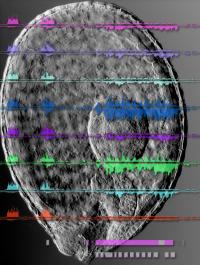
The image shows a growth-arrested embryo from a mutant Arabidopsis plant that contains a genetic lesion in a gene encoding an essential part of the exosome. The embryo is overlaid on a genome browser image of tiling expression data from an intergenic region that exhibits strong upregulation of a cluster of novel tandem repeat-associated, exosome-regulated transcripts. Cells keep a close watch over the transcriptome – the totality of all parts of the genome that are expressed in any given cell at any given time. Researchers at the Salk Institute for Biological Studies and the University of Missouri-Kansas City teamed up to peel back another layer of transcriptional regulation and gain new insight into how genomes work.
| Full story | 0 Comments | 11551 views |

- In some genetic cases of microcephaly, stem cells fail to launch
- Yale team discovers how Zika virus causes fetal brain damage
- Scientists uncover the way a common cell enzyme alerts the body to invading bacteria
- Arctic gives clues on worst mass extinction of life
- Calcium channel blockers caught in the act at atomic level
Search Bio News Net
Free Biology Newsletter
- Flexibility That A.C.A. Lent to Work Force Is Threatened by...International Herald Tribune
- Bacteria Behind Legionnaires’ Disease Found at New York Police StationInternational Herald Tribune
- Prescription Price Crisis? 28 Million Americans See Spike in Drug...MSNBC.com: Health
- Seizing on Opioid Crisis, a Drug Maker Lobbies Hard for...International Herald Tribune
- Republicans are taking a big political risk on health careAP Health News
- Why We're So Divided Over Saving WolvesNational Geographic News