


The new analyses revealed today from the STEP HIV vaccine clinical trial are both disappointing and puzzling. At this time, the data offer no clear explanations as to why the vaccine showed no measurable efficacy or why among individuals with background immunity to the adenovirus vector, there were more HIV infections in the vaccinees as compared to those in the placebo group. Analyses of the STEP data are continuing, and it will take some time before we fully understand these results.

| Bioinformatics | November 8, 2007 05:45 PM |
The complete genomes of 12 related species of the fly Drosophila are published this week in the journal Nature. One of the 12, Drosophila melanogaster, is widely used in studies of genetics and development, and its genome was published in 2000. The new work refines understanding of fruit fly genomics, but it also has implications for understanding the human genome.
| Full story | 0 Comments | 5422 views |

| Biology | November 8, 2007 04:45 PM |
A new study appearing online on November 8th in Current Biology, a publication of Cell Press, offers new insight into how wild house mice avoid mating with their relatives. The mice rely on a diverse set of specially evolved proteins in their urine, called major urinary proteins (MUPs), to identify relatives and avoid mating with them.
| Full story | 0 Comments | 8528 views |

| Molecular & Cell Biology | November 8, 2007 03:45 PM |
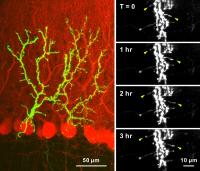
Left: An image of the cerebellum showing labeled main trunk axons (green) and their target neurons (red), with which they form synapses. This image was not made from a living animal, but rather from a thin slice of fixed brain tissue. Right: Exemplar time-lapse images of axon in the intact brain of a living, anesthetized adult mouse. Both the degree of magnification and the orientation of the axon are different from the ones shown in the left picture. The main axon trunk was stable but a few side-branches showed elongation over a period of several hours (yellow arrowheads). Credit: Johns Hopkins Medicine It’s a general belief that the circuitry of young brains has robust flexibility but eventually gets “hard-wired” in adulthood. As Johns Hopkins researchers and their colleagues report in the Nov. 8 issue of Neuron, however, adult neurons aren’t quite as rigidly glued in place as we suspect.
| Full story | 0 Comments | 5633 views |
| Molecular & Cell Biology | November 8, 2007 02:45 PM |
Scientists have determined how cardiac cells die just as emergency treatments restore blood flow to a heart in distress, a paradox that has long puzzled doctors who are able to relieve pain in patients suffering from blocked arteries but can't stop the damage caused by the renewed rush of blood.
| Full story | 0 Comments | 8238 views |
| Molecular & Cell Biology | November 8, 2007 01:45 PM |
Certain varieties of common fescue lawn grass come equipped with their own natural broad-spectrum herbicide that inhibits the growth of weeds and other plants around them.
| Full story | 0 Comments | 6265 views |

- In some genetic cases of microcephaly, stem cells fail to launch
- Yale team discovers how Zika virus causes fetal brain damage
- Scientists uncover the way a common cell enzyme alerts the body to invading bacteria
- Arctic gives clues on worst mass extinction of life
- Calcium channel blockers caught in the act at atomic level
Search Bio News Net
Free Biology Newsletter
- Flexibility That A.C.A. Lent to Work Force Is Threatened by...International Herald Tribune
- Bacteria Behind Legionnaires’ Disease Found at New York Police StationInternational Herald Tribune
- Prescription Price Crisis? 28 Million Americans See Spike in Drug...MSNBC.com: Health
- Seizing on Opioid Crisis, a Drug Maker Lobbies Hard for...International Herald Tribune
- Republicans are taking a big political risk on health careAP Health News
- Why We're So Divided Over Saving WolvesNational Geographic News