

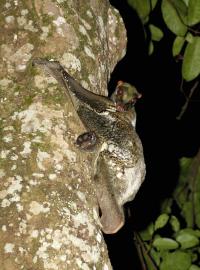
Colugos, like this mother and baby (Cynocephalus variegatus) from southeast Asia, represent the taxonomic group that is the closest to primates, according to a new study to be published in Science on Nov. 2, 2007. Credit: Norman Lim, National University of Singapore While the human species is unquestionably a member of the Primate group, the identity of the next closest group to primates within the entire class of living mammals has been hotly debated. Now, new molecular and genomic data gathered by a team including Webb Miller, a professor of biology and computer science and engineering at the Penn State University, has shown that the colugos -- nicknamed the flying lemurs -- is the closest group to the primates. A paper announcing the results will be published in the journal Science on 2 November, 2008. The team was led by William J. Murphy, associate professor in the Department of Veterinary Integrative Biosciences at Texas A & M University.

| Biology | November 2, 2007 06:40 PM |
| Full story | 0 Comments | 7046 views |

| Biotechnology | November 2, 2007 05:40 PM |
A new way to combat resistant pests stems from discovering how the widely used natural insecticide Bt kills insects.
| Full story | 0 Comments | 6467 views |

| Health & Medicine | November 2, 2007 04:40 PM |
Nursing mothers needn't worry. A new study shows that breastfeeding does not increase breast sagging. University of Kentucky plastic surgeon Dr. Brian Rinker and his colleagues conducted the study with patients at UK HealthCare Cosmetic Surgery Associates. The study found that breastfeeding does not adversely affect breast shape.
| Full story | 0 Comments | 6845 views |

| Molecular & Cell Biology | November 2, 2007 02:40 PM |
In their upcoming G&D paper, Dr. Robert Tjian (UC Berkeley) and colleagues reveal how histone gene expression is differentially regulated during Drosophila development. The researchers demonstrate that different basal transcription factors drive expression of the histone gene cluster, lending new insight into the regulation of metazoan transcription.
| Full story | 0 Comments | 6664 views |

| AIDS & HIV | November 2, 2007 12:40 PM |
Even though effective drug cocktails have improved the outlook for many patients with HIV, disease progression, including the time from AIDS onset to death, varies widely from patient to patient. Now, a study led by the University of North Carolina at Chapel Hill School of Medicine provides new evidence that psychological factors play a role in disease progression.
| Full story | 0 Comments | 6318 views |

- In some genetic cases of microcephaly, stem cells fail to launch
- Yale team discovers how Zika virus causes fetal brain damage
- Scientists uncover the way a common cell enzyme alerts the body to invading bacteria
- Arctic gives clues on worst mass extinction of life
- Calcium channel blockers caught in the act at atomic level
Search Bio News Net
Free Biology Newsletter
- Flexibility That A.C.A. Lent to Work Force Is Threatened by...International Herald Tribune
- Bacteria Behind Legionnaires’ Disease Found at New York Police StationInternational Herald Tribune
- Prescription Price Crisis? 28 Million Americans See Spike in Drug...MSNBC.com: Health
- Seizing on Opioid Crisis, a Drug Maker Lobbies Hard for...International Herald Tribune
- Republicans are taking a big political risk on health careAP Health News
- Why We're So Divided Over Saving WolvesNational Geographic News