


The emergence of drug resistant forms of HIV often underlies the failure of current antiretroviral therapies for HIV infection. Specific mutations in the HIV genome confer resistance to individual drugs. Recombination, a process similar to sexual reproduction in higher organisms, can accelerate the accumulation of resistance mutations by mixing the contents of distinct viral genomes and expedite the failure of therapy. The dynamics of the emergence of recombinant forms of HIV in infected individuals remains poorly understood.

| Biology | October 27, 2007 10:07 PM |
Hainan, China (Oct. 25, 2007) – Mankind’s closest living relatives – the world’s apes, monkeys, lemurs and other primates – are under unprecedented threat from destruction of tropical forests, illegal wildlife trade and commercial bushmeat hunting, with 29 percent of all species in danger of going extinct, according to a new report by the Primate Specialist Group of IUCN’s Species Survival Commission (SSC) and the International Primatological Society (IPS), in collaboration with Conservation International (CI).
| Full story | 0 Comments | 8064 views |
| Biology | October 27, 2007 09:07 PM |
Scientists have shown that birds with higher stress levels adopt bolder behaviour than their normally more relaxed peers in stressful situations. A University of Exeter research team studied zebra finches, which had been selectively bred to produce three distinct types – ‘laid-back’, ‘normal’ and ‘stressed’ – based on their levels of stress hormone. The group was surprised to find that the ‘stressed’ birds were bolder and took more risks in a new environment than the group that was usually more laid-back. Their findings are published today (26 October) in the journal Hormones and Behaviour.
| Full story | 0 Comments | 7499 views |
| Biology | October 27, 2007 08:07 PM |
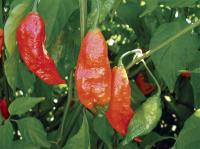
Fruits of Bhut Jolokia on plants grown in the field at the Leyendecker Plant Science Research Center. Researchers at New Mexico State University recently discovered the world’s hottest chile pepper. Bhut Jolokia, a variety of chile pepper originating in Assam, India, has earned Guiness World Records’ recognition as the world’s hottest chile pepper by blasting past the previous champion Red Savina. In replicated tests of Scoville heat units (SHUs), Bhut Jolokia reached one million SHUs, almost double the SHUs of Red Savina, which measured a mere 577,000.
| Full story | 0 Comments | 11979 views |
| Biology | October 27, 2007 07:07 PM |
A new study explores the role of natural enemies, such as predators and parasites, for mixed mating, a reproductive strategy in which hermaphroditic plants and animals reproduce through both self- and cross-fertilization. The findings highlight the possible evolutionary consequences of these interactions.
| Full story | 0 Comments | 6968 views |
| Biology | October 27, 2007 06:07 PM |
Fossil remains of Neanderthals paint an incomplete picture; they cannot tell us about their cognitive skills or give us details of what they looked like. Since scientists in Svante Paabo's team at the Max Planck Institute for Evolutionary Anthropology in Leipzig started looking into the DNA of Neanderthals, they have made some new and astonishing discoveries. Just last week, the Leipzig scientists published their discovery of the human variant of the FOXP2 gene in our nearest relatives. And they have now revealed another interesting detail: at least one percent of the Neanderthals in Europe may have had red hair, according to a report by researchers working with Carles Lalueza-Fox at the University of Barcelona, Holger Rompler at the University of Leipzig and Michael Hofreiter at the Max Planck Institute in Leipzig in the online edition of Science (Science Express, October 25, 2007).
| Full story | 0 Comments | 9958 views |

| Microbiology | October 27, 2007 04:07 PM |
Microbes such as bacteria tend to live in complex colonies called biofilms, where there can resist antibiotics and cause more problems for the immune system. Biofilms comprising millions of bacteria are at the root of many serious chronic infectious diseases such as cystic fibrosis and periodontal disease, as well as industrial contamination, biofouling and biocorrosion.
| Full story | 0 Comments | 7196 views |

| Environment | October 27, 2007 02:07 PM |
Humans are fundamentally altering the Earth’s chemistry. Many of society’s most pressing environmental problems, from climate change to acid rain, stem from human activities that disrupt natural chemical cycles. Moving toward a sustainable future will depend on identifying and reversing actions that have such a huge impact on the Earth’s chemistry.
| Full story | 0 Comments | 7552 views |

- In some genetic cases of microcephaly, stem cells fail to launch
- Yale team discovers how Zika virus causes fetal brain damage
- Scientists uncover the way a common cell enzyme alerts the body to invading bacteria
- Arctic gives clues on worst mass extinction of life
- Calcium channel blockers caught in the act at atomic level
Search Bio News Net
Free Biology Newsletter
- Flexibility That A.C.A. Lent to Work Force Is Threatened by...International Herald Tribune
- Bacteria Behind Legionnaires’ Disease Found at New York Police StationInternational Herald Tribune
- Prescription Price Crisis? 28 Million Americans See Spike in Drug...MSNBC.com: Health
- Seizing on Opioid Crisis, a Drug Maker Lobbies Hard for...International Herald Tribune
- Republicans are taking a big political risk on health careAP Health News
- Why We're So Divided Over Saving WolvesNational Geographic News