
 Print Article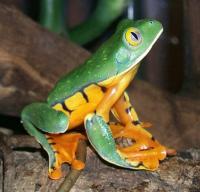
The splendid leaf frog. A brightly coloured tropical frog under threat of extinction is the focus of a new research project hoping to better understand how environment and diet influence its development and behaviour.
Biologists from The University of Manchester have teamed up with experts at Chester Zoo in the hope that their findings will not only help save the splendid leaf frog Cruziohyla calcarifer from extinction in the wild but provide clues as to how it can be better catered for in zoos and aquariums.
Loss of habitat in its native Costa Rican rainforest, combined with global declines in amphibian populations generally through a combination of environmental change and disease, have all contributed to the splendid leaf frog’s precarious situation.
“This research aims to contribute to our understanding of the basic factors that influence the development and survival of these frogs,” said Dr Richard Preziosi, a lecturer in the University’s Faculty of Life Sciences, who is supervising the project.
“For instance, with the exception of certain mammals, we know surprisingly little about what animals should be eating. And yet the diet of splendid leaf frogs affects their colouration which, in turn, determines their mating behaviour.
“The global decline in amphibian populations means research such as this, carried out ex situ, is therefore critical for both conservation projects in the wild and for maintaining and successfully breeding the frogs in zoos and aquariums.”
The research at Chester Zoo is being complemented by field studies being conducted by Dr Preziosi and Manchester Museum’s Curator of Herpetology, Andrew Gray, in the Costa Rican jungle.
“The combination of our fieldwork and the project at Chester Zoo will provide us with a much better idea of the nutritional requirements of this species,” said Dr Preziosi.
“In the wild these animals live in the tree canopy of the rainforest and are exposed to sunlight for long periods of time, so this study will also examine the effect that ultraviolet rays have on the fitness and viability of captive-bred frogs.”
Nearly a third of the world’s 6,000 amphibian species are threatened with extinction and more than 120 species have already vanished from the planet.
Across the globe, conservation organisations and professionals are mobilising efforts to help save as many of these species as possible.
As part of the response, a new organisation known as the Amphibian Ark (AArk) has been set up to help other conservation organisations assist in the effort.
Kevin Buley, Head of Zoo Programmes at Chester, said: “This study will help benefit the conservation breeding of amphibians in European zoos and aquariums.
“As such, it will also help to save many critically endangered species from extinction as part of the global amphibian ark initiative.”
Source : University of Manchester
 Mail to a Friend
 Link to this article

