

Soils may dictate the array of fall colors as much as the trees rooted in them, according to a forest survey out of North Carolina.

| Health & Medicine | October 25, 2007 10:07 PM |
Approximately one-third of the world’s population is infected with Mycobacterium tuberculosis, the bacterium that causes TB, and an estimated 1.6 million people died of the disease in 2005. Currently, TB patients must adhere to a complex treatment regimen over a six- to nine-month period. This demanding schedule often results in patients skipping treatment doses, which has given rise to drug-resistant strains of M. tuberculosis, including multi-drug-resistant (MDR) and, more recently, extensively drug-resistant (XDR) TB.
| Full story | 0 Comments | 6154 views |

| Molecular & Cell Biology | October 25, 2007 09:07 PM |
The shortage of islet cells limits the development of islet transplantation. One new approach was reported in the October 21 issue of the World Journal of Gastroenterology because of its great significance in enhancing the output of islet cells. This article will undoubtedly bring benefit to diabetic patients.
| Full story | 0 Comments | 6511 views |

| Biology | October 25, 2007 08:07 PM |

The splendid leaf frog. A brightly coloured tropical frog under threat of extinction is the focus of a new research project hoping to better understand how environment and diet influence its development and behaviour.
| Full story | 1 Comment | 10902 views |
| Health & Medicine | October 25, 2007 07:07 PM |
Researchers at the University of Leeds have made a breakthrough in understanding a virus which poses one of the greatest global disease threats to wild carnivores including lions, African wild dogs and several types of seal.
| Full story | 0 Comments | 7658 views |
| Biology | October 25, 2007 06:07 PM |
The greatest mass extinction in Earth’s history also may have been one of the slowest, according to a study that casts further doubt on the extinction-by-meteor theory.
| Full story | 0 Comments | 10494 views |
| Biology | October 25, 2007 05:07 PM |
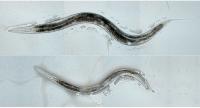
The larger worm in the top image is a hermaphrodite -- a worm with male and female organs -- while the worm on the bottom is male. Biologists at the Brain Institute at the University of Utah genetically manipulated the brains of hermaphrodite worms so they were attracted to other worms of the same sex. The study showed sexual orientation is wired in the worms' brains. Credit: Jamie White, University of Utah University of Utah biologists genetically manipulated nematode worms so the animals were attracted to worms of the same sex – part of a study that shows sexual orientation is wired in the creatures’ brains.
| Full story | 0 Comments | 12011 views |
| Biology | October 25, 2007 04:07 PM |
The genes that make a fruit fly's eyes red also produce red wing patterns in the Heliconius butterfly found in South and Central America, finds a new study by a UC Irvine entomologist.
| Full story | 0 Comments | 8578 views |

| AIDS & HIV | October 25, 2007 03:07 PM |
It was hoped that as HIV treatment improved and as HIV-related public health initiatives encouraged people to be tested for the disease and seek care, that HIV-infected patients would seek care quickly. Unfortunately, a new study indicates that patients are actually sicker when they begin therapy. The study is published in the November 15 issue of Clinical Infectious Diseases, currently available online.
| Full story | 0 Comments | 6920 views |

- In some genetic cases of microcephaly, stem cells fail to launch
- Yale team discovers how Zika virus causes fetal brain damage
- Scientists uncover the way a common cell enzyme alerts the body to invading bacteria
- Arctic gives clues on worst mass extinction of life
- Calcium channel blockers caught in the act at atomic level
Search Bio News Net
Free Biology Newsletter
- Flexibility That A.C.A. Lent to Work Force Is Threatened by...International Herald Tribune
- Bacteria Behind Legionnaires’ Disease Found at New York Police StationInternational Herald Tribune
- Prescription Price Crisis? 28 Million Americans See Spike in Drug...MSNBC.com: Health
- Seizing on Opioid Crisis, a Drug Maker Lobbies Hard for...International Herald Tribune
- Republicans are taking a big political risk on health careAP Health News
- Why We're So Divided Over Saving WolvesNational Geographic News