

When faced with adversity, some people succumb to debilitating psychological diseases including posttraumatic stress disorder and depression, while others are able to remain remarkably optimistic. Now, a new mouse study in the October 19 issue of the journal Cell, a publication of Cell Press, reveals that the difference may depend in part on the chemistry of the brains’ reward circuits. The findings could point to new psychiatric drugs, and perhaps even new ways to encourage resilience for people in high-stress circumstances, including soldiers in combat, disaster relief workers, and disaster victims, according to the researchers.

| Biology | October 18, 2007 10:15 PM |
A new study published online on October 18th in Current Biology reveals that adaptive changes in a human gene involved in speech and language were shared by our closest extinct relatives, the Neandertals. The finding reveals that the human form of the gene arose much earlier than scientists had estimated previously. It also raises the possibility that Neandertals possessed some of the prerequisites for language.
| Full story | 0 Comments | 6996 views |

| Environment | October 18, 2007 09:15 PM |
Shiny amber jewelry and a mucky Florida swamp have given scientists a window into an ancient ecosystem that could be anywhere from 15 million to 130 million years old.
| Full story | 0 Comments | 6907 views |
| Biology | October 18, 2007 08:15 PM |
Bats are the most vocal mammals other than humans, and understanding how they communicate during their nocturnal outings could lead to better treatments for human speech disorders, say researchers at Texas A&M University.
| Full story | 0 Comments | 7356 views |

| Microbiology | October 18, 2007 07:15 PM |
Sugars made by plants are rapidly used by microbes living in their roots, according to new research at the University of York, creating a short cut in the carbon cycle that is vital to life on earth.
| Full story | 0 Comments | 7253 views |
| Biology | October 18, 2007 07:11 PM |
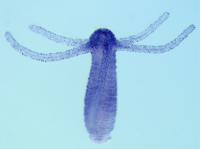
Opsin genes (blue) are present and expressed in the cnidarian Hydra. By peering deep into evolutionary history, scientists at the University of California, Santa Barbara have discovered the origins of photosensitivity in animals.
| Full story | 1 Comment | 6090 views |

| Health & Medicine | October 18, 2007 06:15 PM |
First it was an apple, now it is an aspirin a day that may keep the doctor away. Aspirin has become standard for heart attack prevention, but research published in the online open access journal BMC Medicine suggests that this may really be a man's drug.
| Full story | 0 Comments | 7192 views |
| Biology | October 18, 2007 06:11 PM |
Ocean Conservancy Scientist, Wallace J. Nichols and University of California-Santa Cruz researcher Hoyt Peckham found surprising results in a recent peer-reviewed loggerhead sea turtle study that Nichols and Peckham conducted over the course of 10 years. The full study will be published on October 17 in the online, open-access journal PLoS ONE.
| Full story | 0 Comments | 7973 views |
| Biology | October 18, 2007 05:15 PM |
Sea cucumbers are the champions of organ regrowth because they direct their wound healing abilities towards restoring their organs, according to research published in the online open access journal, BMC Developmental Biology. The discovery that Holothuria glaberrima uses similar cellular mechanisms during wound healing and organ regeneration gives us the opportunity to discover how to repair our own wounds and, perhaps eventually, how to regenerate body parts.
| Full story | 0 Comments | 7999 views |

| Molecular & Cell Biology | October 18, 2007 05:11 PM |
Researchers at the University of Rochester believe they have just confirmed a controversial theory of evolution. The X chromosome is a strikingly powerful force in the origin of new species.
| Full story | 0 Comments | 6621 views |
| Environment | October 18, 2007 04:11 PM |
The world’s oceans are becoming more acid, with potentially devastating consequences for corals and the marine organisms that build reefs and provide much of the Earth’s breathable oxygen.
| Full story | 0 Comments | 8105 views |
| Biology | October 18, 2007 02:11 PM |
Researchers from Kent State University and the University of Bucharest, Romania, have discovered a new primitive crab species Cycloprosopon dobrogea in eastern Romania. Previously unexamined, these ancient crabs from the Prosopidae family existed more than 150 million years ago during the Jurassic period.
| Full story | 0 Comments | 6676 views |
| Molecular & Cell Biology | October 18, 2007 12:11 PM |
Have you ever wondered why you inherited your mother’s smile but not your father’s height? Researchers at the Universities of Leeds and Dundee are one step closer to unravelling how nature combines both maternal and paternal DNA to create genetically unique offspring.
| Full story | 0 Comments | 8443 views |
| Molecular & Cell Biology | October 18, 2007 10:11 AM |
Scientists at the University of North Carolina at Chapel Hill have identified a gene crucial to the final step of the formation of a functional sperm cell.
| Full story | 0 Comments | 5728 views |

- In some genetic cases of microcephaly, stem cells fail to launch
- Yale team discovers how Zika virus causes fetal brain damage
- Scientists uncover the way a common cell enzyme alerts the body to invading bacteria
- Arctic gives clues on worst mass extinction of life
- Calcium channel blockers caught in the act at atomic level
Search Bio News Net
Free Biology Newsletter
- Flexibility That A.C.A. Lent to Work Force Is Threatened by...International Herald Tribune
- Bacteria Behind Legionnaires’ Disease Found at New York Police StationInternational Herald Tribune
- Prescription Price Crisis? 28 Million Americans See Spike in Drug...MSNBC.com: Health
- Seizing on Opioid Crisis, a Drug Maker Lobbies Hard for...International Herald Tribune
- Republicans are taking a big political risk on health careAP Health News
- Why We're So Divided Over Saving WolvesNational Geographic News