


People who live to 100 or more are known to have just as many—and sometimes even more—harmful gene variants compared with younger people. Now, scientists at the Albert Einstein College of Medicine of Yeshiva University have discovered the secret behind this paradox: favorable “longevity” genes that protect very old people from the bad genes’ harmful effects. The novel method used by the researchers could lead to new drugs to protect against age-related diseases.

| Biology | August 25, 2007 06:51 PM |
Angry bees that fly like mini-missiles could map the futures of unmanned aircraft and planetary explorer robots, thanks to new University of Queensland research backed by the Queensland Government.
| Full story | 0 Comments | 6550 views |
| Biology | August 25, 2007 04:51 PM |

Giant panda. The giant panda is not at an “evolutionary dead end” and could have a long term viable future, according to new research involving scientists from Cardiff University.
| Full story | 0 Comments | 8352 views |
| Biology | August 25, 2007 02:51 PM |
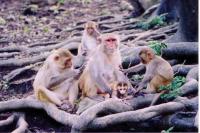
Female rhesus monkeys use special vocalizations when interacting with their infants, the way human adults use "baby talk, " to engage babies’ attention. Female rhesus monkeys use special vocalizations while interacting with infants, the way human adults use motherese, or “baby talk,” to engage babies’ attention, new research at the University of Chicago shows. “Motherese is a high pitched and musical form of speech, which may be biological in origin,” said Dario Maestripieri, Associate Professor in Comparative Human Development at the University. “The acoustic structure of particular monkey vocalizations called girneys may be adaptively designed to attract young infants and engage their attention, similar to how the acoustic structure of human motherese, or baby talk, allows adults to visually or socially engage with infants.”
| Full story | 0 Comments | 6326 views |

| Microbiology | August 25, 2007 12:51 PM |
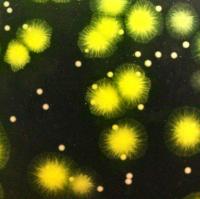
Bacterial colonies of cooperators (green) and cheats (white), growing on agar. Cheats exploit cooperators by stealing their scavenged iron supplies. Cooperation is widespread in the natural world but so too are cheats – mutants that do not contribute to the collective good but simply reap the benefits of others’ cooperative efforts. In evolutionary terms, cheats should indeed prosper, so how cooperation persists despite the threat of cheat takeover is a fundamental question. Recently, biologists at the Universities of Edinburgh and Oxford have found that in bacteria, cheats actually orchestrate their own downfall.
| Full story | 0 Comments | 5518 views |

| Health & Medicine | August 25, 2007 10:51 AM |
Planning for a summer delivery for your child? You might want to choose an ophthalmologist along with an obstetrician.
| Full story | 0 Comments | 5558 views |

- In some genetic cases of microcephaly, stem cells fail to launch
- Yale team discovers how Zika virus causes fetal brain damage
- Scientists uncover the way a common cell enzyme alerts the body to invading bacteria
- Arctic gives clues on worst mass extinction of life
- Calcium channel blockers caught in the act at atomic level
Search Bio News Net
Free Biology Newsletter
- Flexibility That A.C.A. Lent to Work Force Is Threatened by...International Herald Tribune
- Bacteria Behind Legionnaires’ Disease Found at New York Police StationInternational Herald Tribune
- Prescription Price Crisis? 28 Million Americans See Spike in Drug...MSNBC.com: Health
- Seizing on Opioid Crisis, a Drug Maker Lobbies Hard for...International Herald Tribune
- Republicans are taking a big political risk on health careAP Health News
- Why We're So Divided Over Saving WolvesNational Geographic News