

Biologists have long thought that a simple on/off switch controls most genes in human cells. Flip the switch and a cell starts or stops producing a particular protein. But new evidence suggests that this model is too simple and that our genes are more ready for action than previously thought.

| General | July 12, 2007 09:23 PM |
Today, delegates representing the 19 member states of the European Molecular Biology Laboratory (EMBL) offered Australia associate membership in EMBL’s international community. The membership is planned to start officially in January 2008 and will initially last for seven years.
| Full story | 0 Comments | 10767 views |

| Molecular & Cell Biology | July 12, 2007 08:54 PM |
Researchers at Duke University's Pratt School of Engineering have uncovered a missing link in scientists' understanding of the physical forces that give DNA its famous double helix shape.
| Full story | 0 Comments | 7807 views |

| Microbiology | July 12, 2007 08:23 PM |
To protect us from disease our immune system employs macrophages, cells that roam our body in search of disease-causing bacteria. With the help of long tentacle-like protrusions, macrophages can catch suspicious particles, pull them towards their cell bodies, internalise and destroy them. Using a special microscopy technique, researchers from the European Molecular Biology Laboratory (EMBL) now for the first time tracked the dynamic behaviour of these tentacles in three dimensions. In the current online issue of PNAS they describe a molecular mechanism that likely underlies the tentacle movement and that could influence the design of new nanotechnologies.
| Full story | 0 Comments | 5478 views |
| Molecular & Cell Biology | July 12, 2007 07:54 PM |
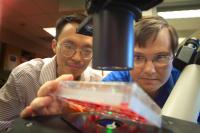
Cell biologist Zheng Dong (left) and graduate student Craig Brooks. When a cell is seriously stressed, say by a heart attack, stroke or cancer, a protein called Bak just may set it up for suicide, researchers have found.
| Full story | 0 Comments | 4776 views |

| Environment | July 12, 2007 07:23 PM |
Brightly coloured birds are among the species most adversely affected by the high levels of radiation around the Chernobyl nuclear plant, ecologists have discovered. The findings – published online in the British Ecological Society's Journal of Applied Ecology – help explain why some species are harder hit by ionising radiation than others.
| Full story | 0 Comments | 5133 views |

| Biology | July 12, 2007 06:54 PM |

Shown is a male Hypolimnas bolina, also called the Blue Moon or Great Eggfly butterfly. A male-killing bacteria has led to skewed sex ratios in populations of H. bolina in the South Pacific, but researchers have found that male butterflies on some islands have bounced back thanks to the rise of a suppressor gene. Credit: Sylvain Charlat An international team of researchers has documented a remarkable example of natural selection in a tropical butterfly species that fought back - genetically speaking - against a highly invasive, male-killing bacteria.
| Full story | 0 Comments | 5328 views |
| Molecular & Cell Biology | July 12, 2007 06:23 PM |
A chemically-modified version of a mitochondrial toxin long used to control species of invasive fish in lakes has been found to selectively inhibit two "survival proteins” in cancer cells. The research is a first step toward developing a molecularly-targeted drug that could eliminate cellular-level resistance to multiple types of chemotherapy and radiation therapy found in many types of cancers.
| Full story | 0 Comments | 3600 views |
| Molecular & Cell Biology | July 12, 2007 05:54 PM |
Scientists have only recently begun to speculate that what’s referred to as “junk” DNA – the 96 percent of the human genome that doesn’t encode for proteins and previously seemed to have no useful purpose – is present in the genome for an important reason. But it wasn’t clear what the reason was. Now, researchers at the University of California, San Diego (UCSD) School of Medicine have discovered one important function of so-called junk DNA.
| Full story | 0 Comments | 4340 views |

| Health & Medicine | July 12, 2007 05:23 PM |
Researchers from the University of Pittsburgh School of Medicine report a significant new advance in the search for an effective treatment for human liver cancer in the July issue of Molecular Cancer Therapeutics. Using a newly available monoclonal antibody, they demonstrated significant reductions in tumor cell proliferation and survival in human and mouse hepatocellular cancer (HCC) cell lines. According to the researchers, this finding has significant implications not only for the treatment of liver cancer but for a number of different types of cancer.
| Full story | 0 Comments | 5018 views |
| Environment | July 12, 2007 04:23 PM |
Scientists at the University of Minnesota have been evaluating the impact of antibiotic feeding in livestock production on the environment. This particular study, funded by the United States Department of Agriculture (USDA), evaluated whether food crops accumulate antibiotics from soils spread with manure that contains antibiotics. Results from the study are published in the July-August 2007 issue of the Journal of Environmental Quality. The research was also presented in Indianapolis, IN at the Annual Soil Science Society of America Meeting in November 2006.
| Full story | 0 Comments | 6124 views |
| Molecular & Cell Biology | July 12, 2007 02:23 PM |
Scientists at the University of Bonn, together with colleagues from Romania, have discovered a gene variant that significantly increases the risk of developing gallstones (Hepatology No. 46, 11 July 2007, DOI 10.1002/hep.21847). It is estimated that one in ten Europeans has this variant in their hereditary disposition. For those affected, the likelihood of developing a gallstone in the course of their life is two to three times higher. The relevant gene contains the instructions for building a molecular pump which transports cholesterol from the liver into the bile ducts – cholesterol being the substance from which most gallstones are formed. The genetic modification appears to cause this pump to work permanently at high speed. Gallstones are a common disorder: in Germany alone more than 170,000 gallbladder operations a year are performed.
| Full story | 0 Comments | 4836 views |
| Molecular & Cell Biology | July 12, 2007 12:23 PM |
A research team at the Swedish medical university Karolinska Institutet has shown for the time that microRNA, small RNA molecules, may play an important role in the development of inflammatory skin diseases such as psoriasis and atopic eczema. The research team is led by Professor Mona Ståhle, one of Sweden’s most prominent scientists in the field.
| Full story | 0 Comments | 7238 views |
| Biology | July 12, 2007 10:23 AM |
A Cornell study of genome sequences in African-Americans, European-Americans and Chinese suggests that natural selection has caused as much as 10 percent of the human genome to change in some populations in the last 15,000 to 100,000 years, when people began migrating from Africa.
| Full story | 0 Comments | 5057 views |

- In some genetic cases of microcephaly, stem cells fail to launch
- Yale team discovers how Zika virus causes fetal brain damage
- Scientists uncover the way a common cell enzyme alerts the body to invading bacteria
- Arctic gives clues on worst mass extinction of life
- Calcium channel blockers caught in the act at atomic level
Search Bio News Net
Free Biology Newsletter
- Flexibility That A.C.A. Lent to Work Force Is Threatened by...International Herald Tribune
- Bacteria Behind Legionnaires’ Disease Found at New York Police StationInternational Herald Tribune
- Prescription Price Crisis? 28 Million Americans See Spike in Drug...MSNBC.com: Health
- Seizing on Opioid Crisis, a Drug Maker Lobbies Hard for...International Herald Tribune
- Republicans are taking a big political risk on health careAP Health News
- Why We're So Divided Over Saving WolvesNational Geographic News