

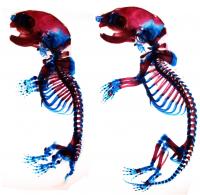
A new, fast and inexpensive way to mutate genes and large, non-gene pieces of DNA has been developed by University of Utah geneticists. They tested the method by mutating a gene involved in bone formation, resulting in short, malformed tail and limbs in the mutant mouse on the left, compared with the skeleton of a normal mouse on the right. The new method promises to speed efforts to learn more about how non-gene portions of DNA control genes to cause human defects and diseases. Credit: Sen Wu, University of Utah Genes account for only 2.5 percent of DNA in the human genetic blueprint, yet diseases can result not only from mutant genes, but from mutations of other DNA that controls genes. University of Utah researchers report in the journal Nature Genetics that they have developed a faster, less expensive technique for mutating those large, non-gene stretches of DNA.

| Molecular & Cell Biology | June 17, 2007 09:37 PM |
| Full story | 0 Comments | 4771 views |
| Molecular & Cell Biology | June 17, 2007 09:37 PM |
A gene responsible for the single most common cause of hearing loss among white adults, otosclerosis, has been identified for the first time, a scientist told the annual conference of the European Society of Human Genetics in Nice, France. Ms Melissa Thys, from the Department of Medical Genetics, University of Antwerp, Belgium, said that this finding may be a step towards new treatments for otosclerosis, which affects approximately 1 in 250 people.
| Full story | 0 Comments | 4406 views |

| Health & Medicine | June 17, 2007 09:37 PM |
Many people are drinking too much water, including sports drinks, when exercising, a practice that could put some individuals engaging in prolonged types of endurance exercise at risk of potentially lethal water intoxication, say international experts who study disorders of water metabolism. Such exercise includes marathons, triathlons, and long distance cycling.
| Full story | 0 Comments | 5405 views |

| Environment | June 17, 2007 09:37 PM |
Celebrated in Buddhist temples and cultivated for its wood and cottony fibers, the kapok tree now is upsetting an idea that biologists have clung to for decades: the notion that African and South American rainforests are similar because the continents were connected 96 million years ago.
| Full story | 0 Comments | 4134 views |

| Microbiology | June 17, 2007 09:37 PM |
A comparison of three parasite species that cause Leishmaniasis has identified a small number of genes, many new to biology, that will provide a framework to target the search for new treatments. Leishmaniasis is a devastating disease that affects about two million people each year and threatens one-fifth of the world's population and new treatments are desperately needed.
| Full story | 0 Comments | 5411 views |

- In some genetic cases of microcephaly, stem cells fail to launch
- Yale team discovers how Zika virus causes fetal brain damage
- Scientists uncover the way a common cell enzyme alerts the body to invading bacteria
- Arctic gives clues on worst mass extinction of life
- Calcium channel blockers caught in the act at atomic level
Search Bio News Net
Free Biology Newsletter
- Flexibility That A.C.A. Lent to Work Force Is Threatened by...International Herald Tribune
- Bacteria Behind Legionnaires’ Disease Found at New York Police StationInternational Herald Tribune
- Prescription Price Crisis? 28 Million Americans See Spike in Drug...MSNBC.com: Health
- Seizing on Opioid Crisis, a Drug Maker Lobbies Hard for...International Herald Tribune
- Republicans are taking a big political risk on health careAP Health News
- Why We're So Divided Over Saving WolvesNational Geographic News