

Scientists may be one step closer to finding new drugs to fight MRSA, cancers and other diseases, after CABI, a leading bioservices organisation announced that its fungal collection will be screened by the University of Strathclyde.

| Health & Medicine | June 13, 2007 05:47 PM |
A common practice among many college students involves "pulling all-nighters", or a single night of total sleep deprivation, a practice associated with lower grade-point averages compared to those who make time for sleep, according to a research abstract that will be presented Wednesday at SLEEP 2007, the 21st Annual Meeting of the Associated Professional Sleep Societies (APSS).
| Full story | 0 Comments | 8950 views |

| Biology | June 13, 2007 04:47 PM |
Being a devoted husband and father is not enough to keep an avian marriage together for the Nazca booby, a long-lived seabird found in the Galapagos Islands off the coast of Ecuador.
| Full story | 0 Comments | 5163 views |
| Biology | June 13, 2007 03:47 PM |
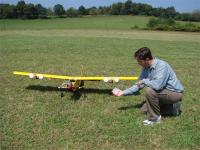
Dr. David Schmale prepares plane to collect Fusarium samples. A Virginia Tech plant pathologist has developed autonomous unmanned aerial vehicles (UAVs) to detect airborne pathogens above agricultural fields.
| Full story | 0 Comments | 4463 views |
| Biology | June 13, 2007 02:47 PM |
Researchers at the University of Missouri-Columbia are studying the status of black bears in Missouri. Black bears were abundant in the state during the 18th and 19th centuries, but have been considered almost extinct in Missouri since the late 19th century. The results of the MU study will be used by the Missouri Department of Conservation to help manage Missouri’s black bear population.
| Full story | 0 Comments | 4101 views |

| Molecular & Cell Biology | June 13, 2007 01:47 PM |
New evidence supports the link between genetic factors and certain adverse events related to smallpox vaccination. The study, published in the July 15th issue of The Journal of Infectious Diseases, now available online, may have implications for predicting adverse events from other live vaccines.
| Full story | 0 Comments | 4093 views |

| Biotechnology | June 13, 2007 12:47 PM |
How can we induce the body to use its own weapon, the immune system, to battle cancer" In principle, by the same means used against infectious diseases: immunization. The production of a selective vaccine is not a trivial task, however. A team led by Horst Kunst at the University of Mainz has now found a way to bind a molecule that is typical for tumors to a carrier protein without irritating the immune system. As they report in the journal Angewandte Chemie, their method is based on an immunocompatible connection by way of a sulfur atom, namely, a thioether.
| Full story | 0 Comments | 4521 views |

- In some genetic cases of microcephaly, stem cells fail to launch
- Yale team discovers how Zika virus causes fetal brain damage
- Scientists uncover the way a common cell enzyme alerts the body to invading bacteria
- Arctic gives clues on worst mass extinction of life
- Calcium channel blockers caught in the act at atomic level
Search Bio News Net
Free Biology Newsletter
- Flexibility That A.C.A. Lent to Work Force Is Threatened by...International Herald Tribune
- Bacteria Behind Legionnaires’ Disease Found at New York Police StationInternational Herald Tribune
- Prescription Price Crisis? 28 Million Americans See Spike in Drug...MSNBC.com: Health
- Seizing on Opioid Crisis, a Drug Maker Lobbies Hard for...International Herald Tribune
- Republicans are taking a big political risk on health careAP Health News
- Why We're So Divided Over Saving WolvesNational Geographic News