

A key hormone enables starving mice to alter their metabolism and “hibernate” to conserve energy, revealing a novel molecular target for drugs to treat human obesity and metabolic disorders, UT Southwestern Medical Center researchers have found.

| Microbiology | June 5, 2007 10:18 PM |
The reality of the threat from vector-borne diseases has been recognized and the problem is prompting research scientists to take a strong interest. Most of these infections, classified as emerging or re-emerging diseases, are linked to ecosystem changes, climatic variations or pressure from human activities. Malaria, sleeping sickness and so on lead to the death of millions of people in the world. African countries are particularly strongly hit. The expansion of Dengue fever and the recent epidemics of Chikungunya and West Nile disease illustrate the trend.
| Full story | 0 Comments | 5228 views |

| Biology | June 5, 2007 09:18 PM |
The growth of most plants depends on the presence of sufficient amounts of nitrogen contained in the soil. However, a family of plants, the legumes, is partially free of this constraint thanks to its ability to live in association with soil bacteria of the Rhizobium, genus, capable of fixing nitrogen from the air. When these bacteria come into contact with their host plant, they trigger in the roots the formation and development of organs, termed nodules, where they continue to live. This close relationship is symbiosis, which benefits both organisms involved: the plant supplies nutritive elements to the bacteria which in return pass on the nitrogen they have stored up.
| Full story | 0 Comments | 5608 views |

| Health & Medicine | June 5, 2007 08:18 PM |
The research found that snoring is in fact part of the spectrum of childhood allergic diseases. So whilst the condition looks and sounds similar in adults and children it can have quite different causes and risk factors.
| Full story | 0 Comments | 4505 views |
| Biology | June 5, 2007 07:18 PM |
CSIRO scientists have joined the battle to save Australia’s iconic Tasmanian devils from the deadly cancer currently devastating devil populations.
| Full story | 0 Comments | 4808 views |
| Health & Medicine | June 5, 2007 06:18 PM |
Carbon monoxide (CO) poisoning kills over 200 people every year in the United States. Although inexpensive CO detectors have been available since 1989, their use in hotels, motels and resorts is not widespread. In fact, while every guest room in the U.S. must contain a smoke detector, there is no federal mandate for CO detectors. In a study published in the July issue of the American Journal of Preventive Medicine, researchers from LDS Hospital report on the incidence and impact of CO poisoning of hotel guests.
| Full story | 0 Comments | 7486 views |
| Microbiology | June 5, 2007 05:18 PM |
It could be an artist’s depiction of someone’s stomach before and after a rather decadent meal. But it is a 3-D cryoelectron microscope reconstruction of the cross-section of a virus, before and after cramming itself full of its own DNA.
| Full story | 0 Comments | 7787 views |

| Molecular & Cell Biology | June 5, 2007 04:18 PM |
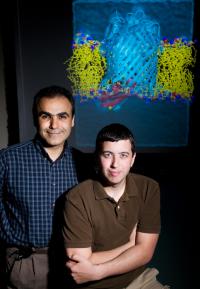
Biochemistry professor Emad Tajkhorshid and graduate student James Gumbart used two software programs developed in the U. of I.'s National Institutes of Health Resource for Macromolecular Modeling and Bioinformatics to painstakingly model a critical part of a mechanism by which bacteria take up large molecules. Credit: Photo by L. Brian Stauffer Using X-ray data and advanced computer simulation and visualization software, researchers at the University of Illinois have painstakingly modeled a critical part of a mechanism by which bacteria take up large molecules. Their findings provide a rare window on the complex interplay of proteins involved in the active transport of materials across cell membranes.
| Full story | 0 Comments | 7156 views |

| AIDS & HIV | June 5, 2007 01:05 PM |
Like hobos on a train, HIV, the virus that causes AIDS, uses a pre-existing transport system to leave one infected cell and infect new ones, Hopkins scientists have discovered. Their findings, published in the June issue of Plos Biology, counter the prevailing belief that HIV and other retroviruses can only leave and enter cells by virus-specific mechanisms.
| Full story | 0 Comments | 5710 views |
| Biology | June 5, 2007 11:05 AM |
Indiana University neuroscientists Olaf Sporns and Christopher Honey find the 98 percent of brain activity that other researchers consider just background noise to be fascinating and important.
| Full story | 0 Comments | 8332 views |
| Microbiology | June 5, 2007 09:05 AM |
Tapping into the unknown world of awakening dormant bacterial spores, researchers have revealed through atomic force microscopy (AFM) the alterations of spore coat and germ cell wall that accompany the transformation from a spore to a vegetative cell.
| Full story | 0 Comments | 5952 views |

- In some genetic cases of microcephaly, stem cells fail to launch
- Yale team discovers how Zika virus causes fetal brain damage
- Scientists uncover the way a common cell enzyme alerts the body to invading bacteria
- Arctic gives clues on worst mass extinction of life
- Calcium channel blockers caught in the act at atomic level
Search Bio News Net
Free Biology Newsletter
- Flexibility That A.C.A. Lent to Work Force Is Threatened by...International Herald Tribune
- Bacteria Behind Legionnaires’ Disease Found at New York Police StationInternational Herald Tribune
- Prescription Price Crisis? 28 Million Americans See Spike in Drug...MSNBC.com: Health
- Seizing on Opioid Crisis, a Drug Maker Lobbies Hard for...International Herald Tribune
- Republicans are taking a big political risk on health careAP Health News
- Why We're So Divided Over Saving WolvesNational Geographic News