

The humble coral may possess as many genes – and possibly even more – than humans do.

| Gene Therapy | May 5, 2007 10:25 PM |
The first clinical trial to test a revolutionary treatment for blindness in children has been announced by researchers at UCL (University College London). The trial, funded by the Department of Health, is the first of its kind and could have a significant impact on future treatments for eye disease.
| Full story | 0 Comments | 9044 views |

| Biology | May 5, 2007 09:25 PM |
One of the most serious and least understood threats to the world's ecosystems is the problem of invasive species-exotic plants, animals and other organisms that are brought into habitats and subsequently spread at a rapid rate, often replacing native species and reducing biodiversity.
| Full story | 0 Comments | 6164 views |

| Biotechnology | May 5, 2007 08:30 PM |
"Put a tree in your tank." Fuel companies aren't touting that slogan. At least not yet.
| Full story | 0 Comments | 6001 views |

| Health & Medicine | May 5, 2007 07:30 PM |
University of Manchester researchers are ridding diabetic patients of the superbug MRSA - by treating their foot ulcers with maggots.
| Full story | 0 Comments | 6624 views |
| Health & Medicine | May 5, 2007 06:30 PM |
Fatigue is one of the most common and distressing symptoms cancer patients experience during chemotherapy and radiation treatment, but it's difficult for health care professionals to accurately assess its severity.
| Full story | 0 Comments | 5020 views |

| Molecular & Cell Biology | May 5, 2007 05:30 PM |
A naturally occurring molecule in the body appears to control whether certain medications, such as beta adrenergic receptor agonists used in acute heart failure or in inhalers for asthma, lose their effectiveness over time.
| Full story | 0 Comments | 5684 views |

| Stem Cell Research | May 5, 2007 04:30 PM |
The skin’s ability to replace the tissue it sloughs off is controlled by a variety of genes. A new study from Harvard Medical School published in the May 4 issue of Cell, however, identifies a "master regulator" of this regeneration process not only for skin, but for many epithelial tissues including breast, prostate, and urogenital tract. This master regulator of epithelial stem cells turns out to be the p63 gene, a close relative to the well-known tumor-suppressing p53 gene. Without p63, mutant mice run out of the regenerative epithelial stem cells. The findings also have implications for cancers of the skin, breast and prostate, which are among the most common human malignancies.
| Full story | 0 Comments | 7466 views |
| Molecular & Cell Biology | May 5, 2007 02:30 PM |
After every meal, the body must prevent the immune system from launching an all-out fight against food. Now, researchers report the identity of a nutrient "floodgate" that serves to protect against such an inflammatory immune response. Their findings appear in the May 4, 2007 issue of the journal Cell, a publication of Cell Press.
| Full story | 0 Comments | 5790 views |
| Molecular & Cell Biology | May 5, 2007 12:30 PM |
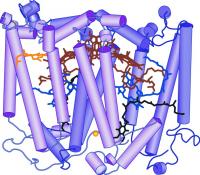
The structure of the L and M subunits of the photosynthetic reaction center from Rhodobacter sphaeroides (based on PDB entry 1PCR). The protein is represented in purple, the cofactors are represented in red, blue, black and yellow. Credit: Professor Neal Woodbury, Biodesign Institute at ASU During the remarkable cascade of events of photosynthesis, plants approach the pinnacle of stinginess by scavenging nearly every photon of available light energy to produce food. Yet after many years of careful research into its exact mechanisms, some key questions remain about this fundamental biological process that supports all life on earth.
| Full story | 0 Comments | 5950 views |
| Health & Medicine | May 5, 2007 10:30 AM |
An oral vaccine can prevent mice from developing a brain disease similar to mad cow disease, according to research that will be presented at the American Academy of Neurology's 59th Annual Meeting in Boston, April 28 – May 5, 2007. Prion diseases, which include scrapie, mad cow disease, and chronic wasting disease, are fatal and there is no treatment or cure.
| Full story | 0 Comments | 4799 views |

- In some genetic cases of microcephaly, stem cells fail to launch
- Yale team discovers how Zika virus causes fetal brain damage
- Scientists uncover the way a common cell enzyme alerts the body to invading bacteria
- Arctic gives clues on worst mass extinction of life
- Calcium channel blockers caught in the act at atomic level
Search Bio News Net
Free Biology Newsletter
- Flexibility That A.C.A. Lent to Work Force Is Threatened by...International Herald Tribune
- Bacteria Behind Legionnaires’ Disease Found at New York Police StationInternational Herald Tribune
- Prescription Price Crisis? 28 Million Americans See Spike in Drug...MSNBC.com: Health
- Seizing on Opioid Crisis, a Drug Maker Lobbies Hard for...International Herald Tribune
- Republicans are taking a big political risk on health careAP Health News
- Why We're So Divided Over Saving WolvesNational Geographic News