

Armed with more than a decade’s worth of statistics, researchers are sounding a new alarm about growing rates of syphilis among gay and bisexual men.

| Biotechnology | April 28, 2007 08:24 PM |
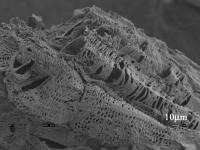
A magnified image of a cornstalk particle shows the many tiny pores that pretreatment -- a phase of the ethanol production process -- opens up. These pores create more surface area for subsequent reactions to take place and give enzymes better access to cellulose, the source for cellulosic ethanol. Researchers said this information could help in establishing an economic method for industrial production of cellulosic ethanol. Credit: Purdue University photo/Meijuan Zeng Tiny pores within plant cells may hold promise for green fuels.
| Full story | 0 Comments | 6880 views |

| Environment | April 28, 2007 07:24 PM |
A team of scientists announced today confirmation of a link between massive volcanic eruptions along the east coast of Greenland and in the western British Isles about 55 million years ago and a period of global warming that raised sea surface temperatures by five degrees (Celsius) in the tropics and more than six degrees in the Arctic.
| Full story | 0 Comments | 9573 views |

| Molecular & Cell Biology | April 28, 2007 06:24 PM |
A role for a microRNA in the immune system has been shown by study of one of the world’s first microRNA knockout mouse, reported Friday 27 April in Science. The microRNA acts as a lynchpin to balance the response of immune defences and the researchers suggest the corresponding human gene will have a similar vital role.
| Full story | 0 Comments | 7134 views |

| Health & Medicine | April 28, 2007 05:24 PM |
Cancer researchers led by Dr. John Dick at Ontario Cancer Institute (OCI) have developed a method to convert normal human blood cells into "human" leukemia stem cells. The converted cells, when transplanted into special mice that permit the growth of human cells, can replicate the entire disease process from the very moment it begins. The findings are published in the journal Science.
| Full story | 0 Comments | 5946 views |

| Stem Cell Research | April 28, 2007 04:24 PM |
Nearly 50% of couples who were interviewed at least 3 years after undergoing in vitro fertilization (IVF) chose to donate their surplus, stored embryos for stem cell research, according to a report by the Spanish Stem Cell Bank in an April 26, 2007, advanced online publication of Cell Stem Cell, a new publication of Cell Press in affiliation with the International Society for Stem Cell Research.
| Full story | 0 Comments | 5972 views |
| Biotechnology | April 28, 2007 02:24 PM |
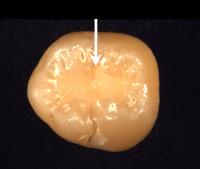
A calcium phosphate nanocomposite filling in a tooth. The nanocomposite can "smartly" release decay-fighting agents to buffer against acids produced by bacteria, and rebuild the lost tooth minerals by releasing ions into the mineral-deficient area of the tooth. Credit: NIST The mouth is a tough environment—which is why dentists do not give lifetime guarantees. Despite their best efforts, a filling may eventually crack under the stress of biting, chewing and teeth grinding, or secondary decay may develop where the filling binds to the tooth. Fully 70 percent of all dental procedures involve replacements to existing repairs, at a cost of $5 billion per year in the United States alone.
| Full story | 0 Comments | 5710 views |
| Biotechnology | April 28, 2007 12:24 PM |
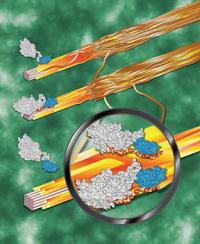
This schematic diagram shows the newly discovered class of plant enzymes with a cellulose-binding module (shown in blue), sticking to a plant cell wall. The binding module of the enzyme helps the catalytic region of the enzyme (shown in more detail in gray in the pullout part of the picture) break down the crystalline cellulose. Credit: Daniel Ripoll and Chris Pelkie/Cornell Theory Center In a breakthrough that could make the production of cellulosic ethanol less expensive, Cornell researchers have discovered a class of plant enzymes that potentially could allow plant materials used to make ethanol to be broken down more efficiently than is possible using current technologies.
| Full story | 0 Comments | 7094 views |
| Molecular & Cell Biology | April 28, 2007 10:24 AM |
Researchers at Johns Hopkins have discovered to their surprise that a drug commonly used to treat toenail fungus can also block angiogenesis, the growth of new blood vessels commonly seen in cancers. The drug, itraconazole, already is FDA approved for human use, which may fast-track its availability as an antiangiogenesis drug.
| Full story | 0 Comments | 7299 views |

- In some genetic cases of microcephaly, stem cells fail to launch
- Yale team discovers how Zika virus causes fetal brain damage
- Scientists uncover the way a common cell enzyme alerts the body to invading bacteria
- Arctic gives clues on worst mass extinction of life
- Calcium channel blockers caught in the act at atomic level
Search Bio News Net
Free Biology Newsletter
- Flexibility That A.C.A. Lent to Work Force Is Threatened by...International Herald Tribune
- Bacteria Behind Legionnaires’ Disease Found at New York Police StationInternational Herald Tribune
- Prescription Price Crisis? 28 Million Americans See Spike in Drug...MSNBC.com: Health
- Seizing on Opioid Crisis, a Drug Maker Lobbies Hard for...International Herald Tribune
- Republicans are taking a big political risk on health careAP Health News
- Why We're So Divided Over Saving WolvesNational Geographic News