

Taking excessive doses of a common vitamin in an attempt to defeat drug screening tests may send the user to the hospital—or worse.

| Biotechnology | April 10, 2007 10:05 PM |
ConocoPhillips will establish an eight-year, $22.5 million research program at Iowa State University dedicated to developing technologies that produce biorenewable fuels. The grant is part of ConocoPhillips' plan to create joint research programs with major universities to produce viable solutions to diversify America's energy sources.
| Full story | 0 Comments | 4636 views |

| Health & Medicine | April 10, 2007 09:05 PM |
Drug-resistant bacteria can complicate treatment after many surgical procedures. In particular, Methicillin-resistant Staphylococcus aureus (MRSA), which has been found in many healthcare settings, can be a serious post-operative complication. In a study published in the April issue of the American Journal of Ophthalmology, researchers found MRSA infections in the eyes of 12 patients after refractive surgery.
| Full story | 0 Comments | 6485 views |
| Health & Medicine | April 10, 2007 08:05 PM |
Scientists from Wake Forest University School of Medicine are the first to report that the stress hormone epinephrine causes changes in prostate and breast cancer cells that may make them resistant to cell death.
| Full story | 0 Comments | 6797 views |

| Molecular & Cell Biology | April 10, 2007 07:05 PM |
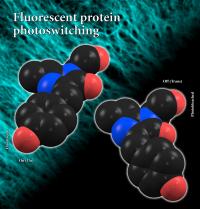
Graphic shows models of the on and off structural alignments of a photoswitchable fluorescent protein. University of Oregon scientists have identified molecular features that determine the light-emitting ability green fluorescent proteins, and by strategically inserting a single oxygen atom they were able to keep the lights turned off for up to 65 hours.
| Full story | 0 Comments | 5116 views |

| Environment | April 10, 2007 06:51 PM |
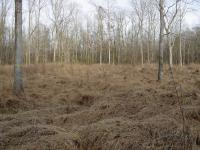
Microstegium can form dense organic mats in the forest understory.
The nonnative invasive grass Microstegium vimineum may hinder the regeneration of woody species in southern forests. Chris and Sonja Oswalt (Forest Service Southern Research Station) and Wayne Clatterbuck (University of Tennessee) set up experiments on a mixed-hardwood forest in southwest Tennessee to study the growth of the invasive grass under different levels of forest disturbance. Study results were published online in the journal Forest Ecology and Management on March 27, 2007.
| Full story | 0 Comments | 6097 views |
| Biotechnology | April 10, 2007 06:05 PM |
An experimental flu vaccine made in insect cells – not in eggs, where flu vaccines currently available in the United States are grown – is safe and as effective as conventional vaccines in protecting people against the flu, according to results published in the April 11 issue of the Journal of the American Medical Association.
| Full story | 0 Comments | 5699 views |
| Molecular & Cell Biology | April 10, 2007 05:51 PM |
An RNA-binding protein that is overproduced in ovarian cancer may present a new target for diagnosis or treatment of ovarian and other cancers, according to researchers at the University of Illinois at Chicago.
| Full story | 0 Comments | 5385 views |
| Health & Medicine | April 10, 2007 05:05 PM |
Over the years, orthopedic surgeon Dennis Crawford, M.D., Ph.D., of Oregon Health & Science University found it difficult to obtain tissue for transplant to treat some of his patients suffering with severe joint disorders.
| Full story | 0 Comments | 4444 views |
| Molecular & Cell Biology | April 10, 2007 04:51 PM |
Building on their 2005 discovery of an enzyme that is a natural tumor suppressor, researchers at the University of California, San Diego (UCSD) School of Medicine have now identified two variants of that enzyme which could provide new targets for therapies to treat diabetes, heart and neurological disease. The findings, by Alexandra C. Newton, Ph.D., UCSD professor of pharmacology, and colleagues are published in the current edition of the journal Molecular Cell.
| Full story | 0 Comments | 4437 views |
| Molecular & Cell Biology | April 10, 2007 02:51 PM |
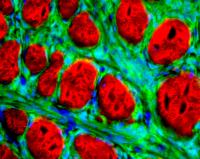
University of Utah researchers have engineered mice that can develop synovial sarcoma, an aggressive and often lethal human cancer that most frequently afflicts teenagers and young adults. The mouse "model" for the human cancer not only should speed the search for new treatments, but revealed the cancer originates in muscle precursor cells called myoblasts. The photo shows a microscopic, cross-section view of part of a synovial sarcoma tumor. The cancerous cells are green and surround red-colored muscle fibers. Cell nuclei are blue, and the cancer cell nuclei are particularly visible. Credit: Malay Haldar, University of Utah University of Utah geneticists have engineered mice that can develop synovial sarcoma – a significant early step toward developing new treatments for the aggressive, deadly cancer that most often kills teenagers and young adults.
| Full story | 0 Comments | 4571 views |

| Biology | April 10, 2007 12:51 PM |
Large mammals--humans, monkeys, and even cats--have brains with a somewhat mysterious feature: The outermost layer has a folded surface. Understanding the functional significance of these folds is one of the big open questions in neuroscience.
| Full story | 0 Comments | 4376 views |
| Biotechnology | April 10, 2007 10:51 AM |
Virologists in the Virginia-Maryland Regional College of Veterinary Medicine (VMRCVM) at Virginia Tech are looking at how a genetically modified variant of Avian Newcastle disease virus (NDV) can treat human prostate cancer.
| Full story | 0 Comments | 4883 views |

- In some genetic cases of microcephaly, stem cells fail to launch
- Yale team discovers how Zika virus causes fetal brain damage
- Scientists uncover the way a common cell enzyme alerts the body to invading bacteria
- Arctic gives clues on worst mass extinction of life
- Calcium channel blockers caught in the act at atomic level
Search Bio News Net
Free Biology Newsletter
- Flexibility That A.C.A. Lent to Work Force Is Threatened by...International Herald Tribune
- Bacteria Behind Legionnaires’ Disease Found at New York Police StationInternational Herald Tribune
- Prescription Price Crisis? 28 Million Americans See Spike in Drug...MSNBC.com: Health
- Seizing on Opioid Crisis, a Drug Maker Lobbies Hard for...International Herald Tribune
- Republicans are taking a big political risk on health careAP Health News
- Why We're So Divided Over Saving WolvesNational Geographic News