

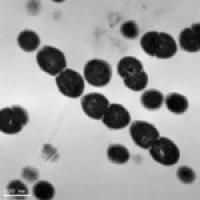
Transmission electron micrograph of S. sanguinis. Virginia Commonwealth University researchers have decoded the genome of a bacteria normally present in the healthy human mouth that can cause a deadly heart infection if it enters the bloodstream.

| Bioinformatics | April 5, 2007 11:16 PM |
| Full story | 0 Comments | 9230 views |

| General | April 5, 2007 10:16 PM |
This week's BMJ investigates a bitter row over a scientific paper that is putting Korea's scientific community under scrutiny once again.
| Full story | 0 Comments | 20404 views |

| Molecular & Cell Biology | April 5, 2007 02:49 PM |
Brain damage that was thought to be caused by hypoglycemic coma actually occurs when glucose is administered to treat the coma, according to a study in rodents led by researchers at the San Francisco VA Medical Center.
| Full story | 0 Comments | 14985 views |
| Molecular & Cell Biology | April 5, 2007 12:49 PM |
While nicotine is highly addictive, researchers have also shown the drug to enhance learning and memory—a property that has launched efforts to develop nicotine-like drugs to treat cognitive deficits in Alzheimer’s and Parkinson’s diseases, schizophrenia, and attention-deficit/hyperactivity disorder.
| Full story | 0 Comments | 8318 views |
| Molecular & Cell Biology | April 5, 2007 10:49 AM |
Every thought, feeling and action originates from the electrical signals emitted by diverse brain cells enmeshed in a tangle of circuits. At this fundamental level, scientists struggle to explain the mind. Worse yet, they have lacked tools to understand what's going wrong in patients with ailments such as depression or Parkinson's disease. New Stanford-led research published in the April 5 issue of Nature describes a technique to directly control brain cell activity with light. It is a novel means for experimenting with neural circuits and could eventually lead to therapies for some disorders.
| Full story | 0 Comments | 18150 views |

- In some genetic cases of microcephaly, stem cells fail to launch
- Yale team discovers how Zika virus causes fetal brain damage
- Scientists uncover the way a common cell enzyme alerts the body to invading bacteria
- Arctic gives clues on worst mass extinction of life
- Calcium channel blockers caught in the act at atomic level
Search Bio News Net
Free Biology Newsletter
- Flexibility That A.C.A. Lent to Work Force Is Threatened by...International Herald Tribune
- Bacteria Behind Legionnaires’ Disease Found at New York Police StationInternational Herald Tribune
- Prescription Price Crisis? 28 Million Americans See Spike in Drug...MSNBC.com: Health
- Seizing on Opioid Crisis, a Drug Maker Lobbies Hard for...International Herald Tribune
- Republicans are taking a big political risk on health careAP Health News
- Why We're So Divided Over Saving WolvesNational Geographic News