

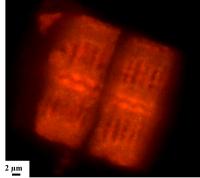
A silicon replica made from diatom microshells glows. The conversion process from the original silica retains the intricate structure of the microshells. The three-dimensional shells of tiny ocean creatures could provide the foundation for novel electronic devices, including gas sensors able to detect pollution faster and more efficiently than conventional devices.

| Microbiology | March 9, 2007 10:07 PM |
| Full story | 0 Comments | 6335 views |

| Biology | March 9, 2007 09:07 PM |
Have your neurons been shouting at your muscles again? It happens, you know.
| Full story | 0 Comments | 5327 views |

| Molecular & Cell Biology | March 9, 2007 08:07 PM |
Ever wonder why some women seem to be more ill-tempered than others? University of Pittsburgh researchers have found that behaviors such as anger, hostility and aggression may be genetic, rooted in variations in a serotonin receptor gene. Indrani Halder, Ph.D., of the Cardiovascular Behavioral Medicine Program at the University of Pittsburgh, will present the findings today at the American Psychosomatic Society's Annual Meeting, held in Budapest, Hungary.
| Full story | 0 Comments | 5686 views |
| Biology | March 9, 2007 07:07 PM |
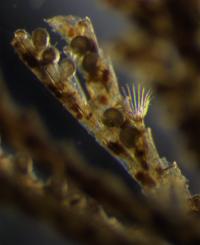
Close-up of the bushy marine bryozoan Bugula neritina. An Oregon Health & Science University researcher believes the discovery of a gene cluster from a bacterium that protects a moss-like marine invertebrate from predators may be the first step toward engineering cancer-fighting drugs.
| Full story | 0 Comments | 6588 views |

| Health & Medicine | March 9, 2007 06:28 PM |
Cancer Treatment Centers of America announced today its plans to launch a new cancer vaccine therapy that expands treatment options for thousands of women with advanced stage ovarian cancer. This innovative treatment will be offered by Cancer Treatment Centers of America and developed by AVAX Technologies, Inc. (OTCMarket: AVXT.OB).
| Full story | 0 Comments | 8556 views |
| Biology | March 9, 2007 06:07 PM |
A whimsical attempt to establish a herd of mouflon for sport hunting on a remote island in the Indian Ocean 50 years ago has inadvertently created a laboratory for genetic researchers and led to a surprising discovery.
| Full story | 0 Comments | 5963 views |
| Biology | March 9, 2007 05:28 PM |
A group of European scientists have determined that a male reindeer's air sac, influencing vocal sound and neck contour, may contribute to his sexual prowess and reproductive success. The results of this research have recently been published in Journal of Anatomy.
| Full story | 0 Comments | 6128 views |
| Microbiology | March 9, 2007 05:07 PM |
The first detailed images of an elusive drug target on the outer wall of bacteria may provide scientists with enough new information to aid design of novel antibiotics. The drugs are much needed to treat deadly infections initiated by Staphylococcus aureus and other bacterial pathogens.
| Full story | 0 Comments | 6437 views |
| Microbiology | March 9, 2007 04:28 PM |
Scientists have discovered that increased levels of ocean acidity and carbon dioxide concentrations have resulted in unexpected changes in oceanic chemical processes. Their research results are published in the March 7, 2007, issue of the journal Geophysical Research Letters.
| Full story | 0 Comments | 6612 views |
| Biology | March 9, 2007 02:28 PM |
Smithsonian scientists have discovered a biodiversity bounty in the Eastern Pacific—approximately 50 percent of the organisms found in some groups are new to science. The research team spent 11 days in the Eastern Pacific, a unique, understudied region off the coast of Panama.
| Full story | 0 Comments | 6290 views |
| Health & Medicine | March 9, 2007 12:28 PM |
An article published in the prestigious international journal 'The Lancet' by researchers from the Menzies School of Health Research (MSHR) in Darwin has revealed a breakthrough in the battle to treat Malaria – a disease which effects 40 per cent of the worlds population.
| Full story | 0 Comments | 6981 views |

| Environment | March 9, 2007 10:28 AM |
Ever since the Norwegians expanded commercial farming of salmon in the 1960s, the industry has continued to rapidly grow worldwide. It has expanded to such a degree that prices for farmed salmon have plummeted and, there is concern that farmed fish may become the next invasive species.
| Full story | 0 Comments | 7531 views |

- In some genetic cases of microcephaly, stem cells fail to launch
- Yale team discovers how Zika virus causes fetal brain damage
- Scientists uncover the way a common cell enzyme alerts the body to invading bacteria
- Arctic gives clues on worst mass extinction of life
- Calcium channel blockers caught in the act at atomic level
Search Bio News Net
Free Biology Newsletter
- Flexibility That A.C.A. Lent to Work Force Is Threatened by...International Herald Tribune
- Bacteria Behind Legionnaires’ Disease Found at New York Police StationInternational Herald Tribune
- Prescription Price Crisis? 28 Million Americans See Spike in Drug...MSNBC.com: Health
- Seizing on Opioid Crisis, a Drug Maker Lobbies Hard for...International Herald Tribune
- Republicans are taking a big political risk on health careAP Health News
- Why We're So Divided Over Saving WolvesNational Geographic News