


The accumulation of genetic damage in our cells is a major contributor to how we age, according to a study being published today in the journal Nature by an international group of researchers. The study found that mice completely lacking a critical gene for repairing damaged DNA grow old rapidly and have physical, genetic and hormonal profiles very similar to mice that grow old naturally. Furthermore, the premature aging symptoms of the mice led to the discovery of a new type of human progeria, a rare inherited disease in which affected individuals age rapidly and die prematurely.

| Microbiology | December 20, 2006 10:38 PM |
The oldest-known animal eggs and embryos, whose first pictures made the cover of Nature in 1998, were so small they looked like bugs – which, it now appears, they may have been.
| Full story | 0 Comments | 7016 views |
| Microbiology | December 20, 2006 09:38 PM |
A team from the Institut Pasteur has recently shown that the tuberculosis bacillus hides from the immune system in its host's fat cells. This formidable pathogen is protected against even the most powerful antibiotics in these cells, in which it may remain dormant for years. This discovery, published in PLoS ONE, sheds new light on possible strategies for fighting tuberculosis. Attempts to eradicate the bacillus entirely from infected individuals should take these newly identified reservoir cells into account.
| Full story | 0 Comments | 5943 views |

| Biology | December 20, 2006 08:38 PM |
The giant dinosaurs had a problem. Many of them had narrow, pointed teeth, which were more suited to tearing off plants rather than chewing them. But how did they then grind their food? Until recently many researchers have assumed that they were helped by stones which they swallowed. In their muscular stomach these then acted as a kind of 'gastric mill'. But this assumption does not seem to be correct, as scientists at the universities of Bonn and Tübingen have now proved. Their research findings can be found in the current issue of the journal Proceedings of the Royal Society (doi:10.1098/rspb.2006.3763).
| Full story | 0 Comments | 6122 views |

| General | December 20, 2006 07:38 PM |
Until now, online scientific journals have been little more than electronic versions of the printed copy. Today, that all changes with the launch of PLoS ONE, which publishes primary research from all areas of science and employs both pre- and post-publication peer review to maximize the impact of every report it publishes. PLoS ONE is published by the Public Library of Science (PLoS), the open access publisher whose goal is to make the world's scientific and medical literature a public resource.
| Full story | 0 Comments | 11678 views |

| Health & Medicine | December 20, 2006 06:38 PM |
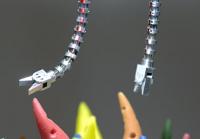
The snake-like robot designed by Johns Hopkins engineers features two thin rods tipped with tentacle-like tools capable of moving with six degrees of freedom. Drawing on advances in robotics and computer technology, Johns Hopkins University researchers are designing new high-tech medical tools to equip the operating room of the future. These systems and instruments could someday help doctors treat patients more safely and effectively and allow them to perform surgical tasks that are nearly impossible today.
| Full story | 0 Comments | 10411 views |

- In some genetic cases of microcephaly, stem cells fail to launch
- Yale team discovers how Zika virus causes fetal brain damage
- Scientists uncover the way a common cell enzyme alerts the body to invading bacteria
- Arctic gives clues on worst mass extinction of life
- Calcium channel blockers caught in the act at atomic level
Search Bio News Net
Free Biology Newsletter
- Flexibility That A.C.A. Lent to Work Force Is Threatened by...International Herald Tribune
- Bacteria Behind Legionnaires’ Disease Found at New York Police StationInternational Herald Tribune
- Prescription Price Crisis? 28 Million Americans See Spike in Drug...MSNBC.com: Health
- Seizing on Opioid Crisis, a Drug Maker Lobbies Hard for...International Herald Tribune
- Republicans are taking a big political risk on health careAP Health News
- Why We're So Divided Over Saving WolvesNational Geographic News