


Researchers at the University of Pennsylvania School of Medicine have discovered how the Kaposi's sarcoma-associated herpesvirus (KSHV) subverts a normal cell process in order to promote tumor growth. The finding, published in the most recent issue of PLoS Pathogens, offers new potential strategies for treating Kaposi's sarcoma and other cancers associated with viruses.

| Health & Medicine | November 8, 2006 10:25 PM |
Scientists have discovered for the first time a specific biochemical pathway by which the sex hormone, androgen, increases levels of harmful chemicals called reactive oxygen species (ROS) in the prostate gland that play a role in the development of prostate cancer.
| Full story | 0 Comments | 6430 views |

| Biology | November 8, 2006 09:25 PM |
Memories of events comprise many components--including sights, sounds, smells, and tastes. Somehow the many features of an episodic memory are woven together into a coherent whole, and researchers have had little understanding of how this binding takes place as the memories are processed by the brain's memory center, the hippocampus. A central question has been whether the hippocampus receives an "episodic packet," or a collection of perceptual strands that it must integrate into a memory.
| Full story | 0 Comments | 8612 views |

| Gene Therapy | November 8, 2006 08:25 PM |
For the first time, researchers have inhibited the development of epilepsy after a brain insult in animals. By using gene therapy to modify signaling pathways in the brain, neurology researchers found that they could significantly reduce the development of epileptic seizures in rats.
| Full story | 0 Comments | 8716 views |
Transplanted photoreceptor precursor cells restore visual function in mice with retinal degeneration |
| Health & Medicine | November 8, 2006 07:25 PM |
Scientists have successfully transplanted light-sensing cells called photoreceptors directly into the eyes of mice and restored their visual function.
| Full story | 0 Comments | 9532 views |

| Molecular & Cell Biology | November 8, 2006 06:25 PM |
Venom from a West Indian tarantula has been shown to cause pain by exciting the same nerve cells in mice that sense high temperatures and the hot, spicy ingredient in chili peppers, UCSF scientists have discovered.
| Full story | 0 Comments | 10663 views |
| Molecular & Cell Biology | November 8, 2006 04:49 PM |
Scientists at Harvard University have developed a computer model that, for the first time, can fully map and predict how small proteins fold into three-dimensional, biologically active shapes. The work could help researchers better understand the abnormal protein aggregation underlying some devastating diseases, as well as how natural proteins evolved and how proteins recognize correct biochemical partners within living cells.
| Full story | 0 Comments | 7491 views |
| Molecular & Cell Biology | November 8, 2006 02:49 PM |
A new brain study finds major differences between women with serious depression and healthy women in a brain-chemical system that's crucial to stress and emotions.
| Full story | 0 Comments | 7245 views |

| Biotechnology | November 8, 2006 12:49 PM |
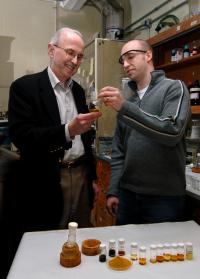
John Verkade, left, a University Professor of chemistry at Iowa State, and Reed Oshel, a graduate student in biorenewable resources and technology, are studying a chemical compound that breaks down... John Verkade remembers just how it happened some 40 years ago: One of his Iowa State University graduate students, David Hendricker, stopped by to report somebody was stealing a little wooden applicator stick from a beaker.
| Full story | 0 Comments | 6462 views |
| Molecular & Cell Biology | November 8, 2006 10:49 AM |
Movements in space create in humans and animals so-called optical flow fields which are characteristic for the movement in question. In a forward movement, the objects flow by laterally, objects at the front increase in size and objects further away hardly change at all. At a higher level in the visual centre in the brain, there must be a computation of the visual information, so that animals can differentiate between their own movement and movement of their environment and are able to correct their course if necessary.
| Full story | 0 Comments | 5625 views |

- In some genetic cases of microcephaly, stem cells fail to launch
- Yale team discovers how Zika virus causes fetal brain damage
- Scientists uncover the way a common cell enzyme alerts the body to invading bacteria
- Arctic gives clues on worst mass extinction of life
- Calcium channel blockers caught in the act at atomic level
Search Bio News Net
Free Biology Newsletter
- Flexibility That A.C.A. Lent to Work Force Is Threatened by...International Herald Tribune
- Bacteria Behind Legionnaires’ Disease Found at New York Police StationInternational Herald Tribune
- Prescription Price Crisis? 28 Million Americans See Spike in Drug...MSNBC.com: Health
- Seizing on Opioid Crisis, a Drug Maker Lobbies Hard for...International Herald Tribune
- Republicans are taking a big political risk on health careAP Health News
- Why We're So Divided Over Saving WolvesNational Geographic News