


How well an individual's immune system controls HIV during the earliest phases of infection appears to depend on both the specific versions of key immune-system molecules called HLA Class I that have been inherited, as well as on the fragments of viral protein those molecules display to the T lymphocytes that usually destroy infected cells. In a report in the November issue of PLOS Medicine, researchers from the Partners AIDS Research Center at Massachusetts General Hospital (PARC/MGH) report that specific HLA Class I/HIV viral fragment combinations are associated with a more powerful antiviral response, findings that may help develop vaccines against HIV.

| Molecular & Cell Biology | November 3, 2006 08:22 PM |
Scientists have answered a long-standing molecular stumper regarding DNA: How can parts of such a rigid molecule bend and coil without requiring large amounts of force? According to a team of researchers from the United States and the Netherlands, led by a physicist from the University of Pennsylvania, DNA is much more flexible than previously believed when examined over extremely small lengths. They used a technique called atomic force microscopy to determine the amount of energy necessary to bend DNA over nano-size lengths (about a million times smaller than a printed letter).
| Full story | 0 Comments | 4324 views |

| Biology | November 3, 2006 08:18 PM |
Why are there more species in the tropics than in the temperate regions of the globe? Many of the world's species live in the tropics (perhaps more than half), but the reason has been debated for more than 100 years.
| Full story | 0 Comments | 7136 views |
| Molecular & Cell Biology | November 3, 2006 07:22 PM |
A growth factor known to be important for the survival of many types of cells stimulates rapid extension of corticospinal motor neurons – critical brain cells that connect the cerebral cortex with the spinal cord and that die in motor neuron diseases like amyotrophic lateral sclerosis (ALS or Lou Gehrig's disease). In the November 2006 issue of Nature Neuroscience, two investigators from Massachusetts General Hospital (MGH) and the Harvard Stem Cell Institute describe how insulin-like growth factor 1 (IGF-1) dramatically increases the in vitro growth of corticospinal motor neuron (CSMN) axons – projections that carry nerve impulses to the spinal motor neurons that connect to muscles – and that blocking IGF-1 activity reduces that growth in both cultured cells and in living mice.
| Full story | 0 Comments | 6849 views |
| Molecular & Cell Biology | November 3, 2006 07:18 PM |
A new study on the ability of liver cells to interact with T cells (lymph cells that play a role in regulating the immune response) found that such interactions do occur and demonstrated the mechanism by which they may take place. The results may help explain the altered immune responses that occur with aging and other conditions and may be useful in developing therapies for viral hepatitis and autoimmune diseases.
| Full story | 0 Comments | 5539 views |

| Health & Medicine | November 3, 2006 06:22 PM |
Using the latest in high tech tools, researchers have identified three proteins that were highly predictive of chronic lung rejection up to 20 months before the rejection occurred.
| Full story | 0 Comments | 6411 views |
| Health & Medicine | November 3, 2006 06:18 PM |
Researchers have evaluated improvements in the end-of-life care in intensive care units (ICU) and have shared their findings in a special supplement to Critical Care Medicine, the journal of the Society of Critical Care Medicine. The supplement is dedicated entirely to end-of-life care in the critical care setting.
| Full story | 0 Comments | 5773 views |
| Biology | November 3, 2006 05:22 PM |
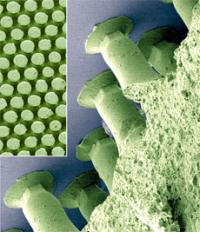
Microscope image of the biomimetic surface structure of the new adhesive material. The material (green), which was inspired by the soles of insects' feet, sticks to the glass (blue). Max Planck Institute for Metals Research Mushroom-shaped microhairs are the secret of a new adhesive material which scientists at the Max Planck Institute for Metals Research in Stuttgart have developed. Inspired by the soles of beetles' feet, and therefore biomimetic, the special surface structure of the material allows it to stick to smooth walls without any adhesives. Potential applications range from reusable adhesive tape to shoe soles for climbing robots and are therefore of considerable relevance to technology (Journal of the Royal Society Interface, 17 October 2006).
| Full story | 0 Comments | 5383 views |
| Health & Medicine | November 3, 2006 02:55 PM |
University of Manchester researchers are recruiting people with backache caused by nerve root pain – commonly known as sciatica – in the first ever study to discover if therapeutic ultrasound can help their condition.
| Full story | 0 Comments | 4916 views |
| Molecular & Cell Biology | November 3, 2006 12:55 PM |
Biologists have learned where and how some plant seeds store iron, a valuable discovery for scientists working to improve the iron content of plants. Their research helps address the worldwide problem of iron deficiency and malnutrition in humans.
| Full story | 0 Comments | 4797 views |
| Molecular & Cell Biology | November 3, 2006 10:55 AM |
When Yadong Wang, a chemist by training, first ventured into nerve regeneration two years ago, he didn't know that his peers would have considered him crazy.
| Full story | 0 Comments | 5937 views |

- In some genetic cases of microcephaly, stem cells fail to launch
- Yale team discovers how Zika virus causes fetal brain damage
- Scientists uncover the way a common cell enzyme alerts the body to invading bacteria
- Arctic gives clues on worst mass extinction of life
- Calcium channel blockers caught in the act at atomic level
Search Bio News Net
Free Biology Newsletter
- Flexibility That A.C.A. Lent to Work Force Is Threatened by...International Herald Tribune
- Bacteria Behind Legionnaires’ Disease Found at New York Police StationInternational Herald Tribune
- Prescription Price Crisis? 28 Million Americans See Spike in Drug...MSNBC.com: Health
- Seizing on Opioid Crisis, a Drug Maker Lobbies Hard for...International Herald Tribune
- Republicans are taking a big political risk on health careAP Health News
- Why We're So Divided Over Saving WolvesNational Geographic News