

Biologists at Washington University in St. Louis have made an important breakthrough in understanding a pathway plant cells take to silence unwanted or extra genes using short bits of RNA. Basically, they have made it possible to see where, and how, the events in the pathway unfold within the cell, and seeing is believing, as the old saying goes.

| Biology | July 13, 2006 10:27 PM |
University of Cambridge scientists have discovered that older meerkats teach pups how to obtain food by incrementally introducing dead, injured and then live prey. Although learning per se wouldn't be surprising, whether wild mammals teach their young was still debated. The findings were published in this week's edition of the journal Science.
| Full story | 0 Comments | 5732 views |

| Environment | July 13, 2006 09:27 PM |
The regions in robins' brains responsible for singing and mating are shrinking when exposed to high levels of DDT, says new University of Alberta research--the first proof that natural exposure to a contaminant damages the brain of a wild animal.
| Full story | 0 Comments | 4591 views |
| Biology | July 13, 2006 08:27 PM |
A massive dinosaur death bed in Alberta has helped map out the animal's life span and thrown doubt on long-held theories about how one species lived, says new research conducted in part at the University of Alberta.
| Full story | 0 Comments | 4104 views |

| Molecular & Cell Biology | July 13, 2006 06:46 PM |
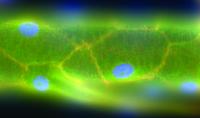
A fluorescence microscopy image of a piece of fruit fly tracheal tube shows the colocalization of transmembrane protein Ninjurin A at the cell surfaces (green), enzyme Mmp1 at the cell surfaces (red), and the cell nuclei (blue).Researchers at Rensselaer Polytechnic Institute have discovered a communication signal between cells that plays an important role in cell adhesion and detachment. The finding provides new information about how cells and tissues determine when to let go from surfaces during new growth, according to the researchers.
| Full story | 0 Comments | 4396 views |

| Biotechnology | July 13, 2006 05:46 PM |
Stanford University researchers demonstrated for the first time the ability to create 3-D positron emission tomography (PET)/computed tomography (CT) images for "fly-through" and "fly-around viewing" of cancer in the lungs and colon, according to a study in the July issue of the Journal of Nuclear Medicine.
| Full story | 0 Comments | 4287 views |
| Molecular & Cell Biology | July 13, 2006 04:46 PM |
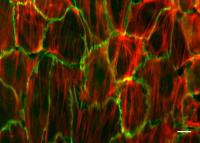
UCSD bioengineers have found a link between parallel alignment of 'stress fibers' in blood vessel cells and healthy levels in those cells of a protein called JNK.Atherosclerotic narrowing and hardening of coronary arteries typically appear first at vessel branches, and a study in the October issue of Cellular Signalling reports that the type of mechanical stretching found at those branches activates a cellular protein known to damage cells. The report is the first to link mechanical forces with structural and biochemical changes in blood vessel cells that could explain why atherosclerotic lesions form preferentially at branches of coronary arteries.
| Full story | 0 Comments | 6011 views |

| Health & Medicine | July 13, 2006 02:46 PM |
Research by Warwick Medical School at the University of Warwick has found that sleep deprivation is associated with an almost a two-fold increased risk of being obese for both children and adults.
| Full story | 0 Comments | 6700 views |
| Health & Medicine | July 13, 2006 12:46 PM |
Researchers, working with colleagues at St George's, University of London, are developing drugs designed to stop allergens from entering the body, so rendering them harmless.
| Full story | 0 Comments | 4503 views |
| Health & Medicine | July 13, 2006 10:46 AM |
In a pair of groundbreaking studies, brain scientists at Carnegie Mellon University and the University of Pittsburgh have discovered that the anatomical differences that characterize the brains of people with autism are related to the way those brains process information.
| Full story | 0 Comments | 4652 views |

- In some genetic cases of microcephaly, stem cells fail to launch
- Yale team discovers how Zika virus causes fetal brain damage
- Scientists uncover the way a common cell enzyme alerts the body to invading bacteria
- Arctic gives clues on worst mass extinction of life
- Calcium channel blockers caught in the act at atomic level
Search Bio News Net
Free Biology Newsletter
- Flexibility That A.C.A. Lent to Work Force Is Threatened by...International Herald Tribune
- Bacteria Behind Legionnaires’ Disease Found at New York Police StationInternational Herald Tribune
- Prescription Price Crisis? 28 Million Americans See Spike in Drug...MSNBC.com: Health
- Seizing on Opioid Crisis, a Drug Maker Lobbies Hard for...International Herald Tribune
- Republicans are taking a big political risk on health careAP Health News
- Why We're So Divided Over Saving WolvesNational Geographic News