

The Wildlife Conservation Society has launched an ambitious new program that calls for a 50 percent increase in tiger numbers in key areas over the next decade, according to an article in this week's journal Nature. The new initiative, called "Tigers Forever," blends a business model with hard science, and has already attracted the attention of venture capitalists who have pledged an initial $10 million to support it.

| Biology | July 6, 2006 10:37 PM |
Fifty of the leading amphibian researchers in the world have called for a new Amphibian Survival Alliance, a $400 million initiative to help reduce and prevent amphibian declines and extinctions, an ecological crisis of growing proportion that is continuing to get worse. In a policy statement to be published Friday in the journal Science, the scientists say that 32 percent of all amphibian species are threatened and at least nine – perhaps as high as 122 – have become extinct since 1980. It's time, they say, for a more organized and effective approach to address the various diseases, habitat loss, invading species and other causes of this problem.
| Full story | 0 Comments | 4717 views |

| Molecular & Cell Biology | July 6, 2006 09:37 PM |
In the July 7, 2006, issue of the journal Science, researchers at the University of Texas Medical Branch at Galveston (UTMB) describe experiments that may soon lead to a test that will enable medical science to estimate how many people are infected with the human form of mad cow disease, which can take as long as 40 years before manifesting itself.
| Full story | 0 Comments | 7038 views |

| Environment | July 6, 2006 08:37 PM |

The aftermath of the Aspen Fire, a large and severe forest fire that occurred in the summer of 2003 in the Santa Catalina Mountains near Tucson, Ariz.Large forest fires have occurred more frequently in the western United States since the mid-1980s as spring temperatures increased, mountain snows melted earlier and summers got hotter, according to new research.
| Full story | 0 Comments | 6388 views |
| Biology | July 6, 2006 07:37 PM |
Leopards may not be able to change their spots, but corals can change their skeletons, building them out of different minerals depending on the chemical composition of the seawater around them.
| Full story | 0 Comments | 4575 views |

| Health & Medicine | July 6, 2006 06:29 PM |
Virginia Commonwealth University researchers studying rapamycin, an antibiotic used to boost organ survival in transplant patients, have found that the drug may protect the heart against tissue damage following acute heart attack.
| Full story | 0 Comments | 4555 views |
| Health & Medicine | July 6, 2006 05:29 PM |
Women at risk for infertility, such as those needing cancer treatment, can freeze mature, fertilized eggs, but the process can take up to six weeks and for some this delay of treatment is not an option.
| Full story | 0 Comments | 5270 views |
| Health & Medicine | July 6, 2006 04:29 PM |
A winner of UniQuest's 2006 Trailblazer innovation competition, Dr Frederic Meunier, is developing a treatment for motoneuronal diseases based on modifying botox –the popular anti-wrinkle treatment.
| Full story | 0 Comments | 3960 views |
| Molecular & Cell Biology | July 6, 2006 02:29 PM |
A drug effective at treating animal models of human autoimmune disorders and other diseases works by dialing down the activity of a key enzyme involved in energy production, University of Michigan researchers have found.
| Full story | 0 Comments | 3202 views |

| Microbiology | July 6, 2006 12:29 PM |
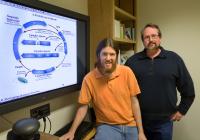
Adam Arkin and Morgan Price with model of operon life cycleIn a breakthrough that will immediately benefit biologists who study bacteria, a team of researchers has determined the life cycle of operons, small groups of genes with related functions that are co-transcribed in a single strand of messenger RNA. These results could also in the future have bearing on the advancement of the emerging field of synthetic biology, in which microbes are genetically engineered to make specific products, such as new medicines or pharmaceutical drugs.
| Full story | 0 Comments | 4299 views |
| Health & Medicine | July 6, 2006 10:29 AM |
Heart researchers at the University at Buffalo have received a $2.5 million five-year grant to develop new strategies to reverse a heart dysfunction called "hibernating myocardium" that can cause disabling heart failure and sudden death.
| Full story | 0 Comments | 4249 views |

- In some genetic cases of microcephaly, stem cells fail to launch
- Yale team discovers how Zika virus causes fetal brain damage
- Scientists uncover the way a common cell enzyme alerts the body to invading bacteria
- Arctic gives clues on worst mass extinction of life
- Calcium channel blockers caught in the act at atomic level
Search Bio News Net
Free Biology Newsletter
- Flexibility That A.C.A. Lent to Work Force Is Threatened by...International Herald Tribune
- Bacteria Behind Legionnaires’ Disease Found at New York Police StationInternational Herald Tribune
- Prescription Price Crisis? 28 Million Americans See Spike in Drug...MSNBC.com: Health
- Seizing on Opioid Crisis, a Drug Maker Lobbies Hard for...International Herald Tribune
- Republicans are taking a big political risk on health careAP Health News
- Why We're So Divided Over Saving WolvesNational Geographic News