

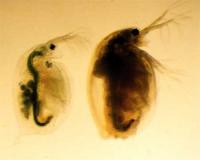
Exposing Daphnia host clones to spores from the castrating bacterium Pasteuria ramosa provides experimental evidence that parasite fitness is maximized at intermediate levels of virulence.
When horror-movie writers run out of ideas, they can always turn to parasites. Imagine the possibilities with flesh-eating bacteria, suicide-inducing hairworms, scalp burrowing botflies--and castrating parasites. Such debilitating effects are an inevitable consequence of infection, but it is in the parasite's interest to avoid killing the host until it can transmit a new crop of pathogens. In the "tradeoff hypothesis" for the evolution of virulence--how quickly a parasite kills its host--host exploitation and parasite reproduction are balanced to maximize the parasite's lifetime transmission success. But lifetime transmission success, an indicator of parasite fitness, has proven difficult to measure, leaving scant direct evidence for an optimal level of virulence. In a new study, Knut Helge Jensen, Dieter Ebert, and colleagues now provide empirical evidence that such a trade-off exists.

| Microbiology | May 29, 2006 09:49 PM |
| Full story | 0 Comments | 9057 views |
| Microbiology | May 29, 2006 08:19 PM |
Tuberculosis remains one of the deadliest threats to public health. Every year two million people die of the disease, which is caused by the microorganism Mycobacterium tuberculosis. Roughly one third of the world's population is infected and more and more bacterial strains have developed resistance to drugs. Researchers from the Hamburg Outstation of the European Molecular Biology Laboratory (EMBL) and the Max Planck Institute for Infection Biology (MPIIB) in Berlin have now obtained a structural image of a protein that the bacterium needs for survival in human cells. This image reveals features of the molecule that could be targeted by new antibiotic drugs. The results appear in this week's online issue of the Proceedings of the National Academy of Sciences (PNAS).
| Full story | 0 Comments | 7501 views |

| Biology | May 29, 2006 07:19 PM |
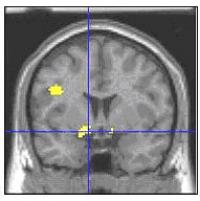
The left amygdala and related structures (yellow area where lines intersect) are part of an emotion-regulating brain circuit where children with bipolar disorder showed greater activation than controls when rating their fear of neutral faces. Structural MRI image with functional MRI data superimposed.Youth with bipolar disorder misread facial expressions as hostile and show heightened neural reactions when they focus on emotional aspects of neutral faces, researchers at the National Institutes of Health's (NIH) National Institute of Mental Health (NIMH) have discovered. The study provides some of the first clues to the underlying workings of the episodes of mania and depression that disrupt friendships, school, and family life in up to one percent of children.
| Full story | 0 Comments | 8516 views |

| Health & Medicine | May 29, 2006 06:16 PM |
ISN's immediate response to this latest quake - to strike the Indonesian island of Java - was to call once again on its Renal Disaster Task Force (RDRTF). Under the leadership of Dr. Raymond Vanholder, the Task Force acted rapidly by sending two scouts to join a team from Médecins Sans Frontières (MSF).
| Full story | 0 Comments | 5678 views |
| Health & Medicine | May 29, 2006 04:16 PM |
A rare genetic defect that can trigger a host of diseases from type 1 diabetes to alopecia has helped explain the imbalance of immune regulator and killer cells in autoimmune disease.
| Full story | 0 Comments | 5747 views |

| Molecular & Cell Biology | May 29, 2006 01:34 PM |
COX-1 and COX-2 enzymes may be blocked by pain medications such as Advil and Vioxx in a more complex manner than was previously understood, a Queen's University study has found.
| Full story | 0 Comments | 4992 views |
| Molecular & Cell Biology | May 29, 2006 12:34 PM |
Working with colleagues from Denmark, Canada, China, and the U.S.A., the scientists have shown how cutting-edge methods can be used to catalogue the entire inventory of active proteins in cell organelles at a particular moment. Their work sheds considerable light on how cells use proteins. The work is published in the journal Cell (Cell 125, 1-13).
| Full story | 0 Comments | 5384 views |
| Molecular & Cell Biology | May 29, 2006 11:34 AM |
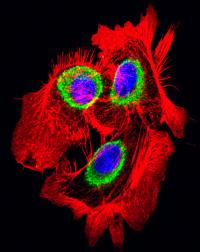
Activity of a tumour suppressor in skin cells. A microscopic image shows three skin cells. In each of them the Cyld protein (green) is situated around the nucleus (blue) and prevents oncogene Bcl-3 from entering. The red structure is the cell's cytoskeleton.Reinhard Fässler led a team which has published an article on this topic in the latest edition of Cell. A protein called Cyld controls Bcl-3 - and thus protects mice from tumour growth. The researchers were able to describe the cellular signalling path which causes uncontrolled growth when the Cyld gene is defective. Furthermore, there is evidence that such a defective Cyld gene may be the root cause of kidney, liver, uterus, and large intestine tumours. Cyld could possibly be one of Bcl-3's most important opponents - in mice and men (Cell, May 19 2006).
| Full story | 0 Comments | 5803 views |

- In some genetic cases of microcephaly, stem cells fail to launch
- Yale team discovers how Zika virus causes fetal brain damage
- Scientists uncover the way a common cell enzyme alerts the body to invading bacteria
- Arctic gives clues on worst mass extinction of life
- Calcium channel blockers caught in the act at atomic level
Search Bio News Net
Free Biology Newsletter
- Flexibility That A.C.A. Lent to Work Force Is Threatened by...International Herald Tribune
- Bacteria Behind Legionnaires’ Disease Found at New York Police StationInternational Herald Tribune
- Prescription Price Crisis? 28 Million Americans See Spike in Drug...MSNBC.com: Health
- Seizing on Opioid Crisis, a Drug Maker Lobbies Hard for...International Herald Tribune
- Republicans are taking a big political risk on health careAP Health News
- Why We're So Divided Over Saving WolvesNational Geographic News