

In the latest issue of the journal Nature, scientists at the National Institute of Allergy and Infectious Diseases (NIAID) of the National Institutes of Health (NIH) describe a new understanding about how long-term immunity works--findings that may lead to new ways of thinking about how to enhance certain immune responses and how to improve vaccines.

| Biology | April 18, 2006 11:51 PM |
The reason people can approach animals in the wild more easily from a car than by foot may be due to an innate "life detector" tuned to the visual movements of an approaching predator's feet, says Queen's University psychologist Niko Troje.
| Full story | 0 Comments | 4898 views |
| Biology | April 18, 2006 11:31 PM |
A study conducted by investigators at Georgia State University and the Atlanta-based Center for Behavioral Neuroscience (CBN) reports that anatomical and functional differences in the brain may explain sex differences in the experience of pain and in the effects of certain drugs on pain.
| Full story | 0 Comments | 7674 views |

| Molecular & Cell Biology | April 18, 2006 10:31 PM |
For the first time, scientists have documented an organ-specific innate immune system. In research published in the April 18 edition of the journal Immunity, scientists at the University of California, San Diego (UCSD) School of Medicine outline the unique mechanism by which the lung shapes its defensive strategies against microbial invasion.
| Full story | 0 Comments | 4850 views |
| Biology | April 18, 2006 09:31 PM |
Cuttlefish are wizards of camouflage. Adept at blending in with their surroundings, cuttlefish are known to have a diverse range of body patterns and can switch between them almost instantaneously. New research from MBL Marine Resources scientists, to appear in the May 2006 issue of the journal Vision Research, confirms that while these masters of disguise change their appearance based on visual cues, they do so while being completely colorblind.
| Full story | 0 Comments | 5449 views |

| Environment | April 18, 2006 08:31 PM |
Dutch researcher Yvonne van Breugel analysed rocks from seabeds millions of years old. Carbon occurs naturally in two stable forms; atomic mass 12 (99 percent) and atomic mass 13 (1 percent). Episodes in the Jurassic and Cretaceous periods were characterised by a relatively strong increase in 12C. The analyses have shown that this was caused by a sudden large-scale release of carbon from stocks stored in the ocean floor or peats and bogs.
| Full story | 0 Comments | 4741 views |
| Molecular & Cell Biology | April 18, 2006 07:30 PM |
Scientists in the Ohio State University Comprehensive Cancer Center say that just one, single, malfunctioning microRNA is sufficient to cause cancer in mice. The discovery offers new insight into the development of some forms of leukemia and lymphoma and at the same time underscores the powerful role that these tiny snippets of non-coding RNA play in cell signaling pathways active in carcinogenesis.
| Full story | 0 Comments | 5420 views |

| Biotechnology | April 18, 2006 06:31 PM |
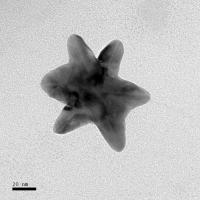
The nanostar's 3-D spikes are visible in this image from a transmission electron microscope.New optics research from Rice University's Laboratory for Nanophotonics suggests that tiny gold particles called nanostars could become powerful chemical sensors.
| Full story | 0 Comments | 5185 views |

- In some genetic cases of microcephaly, stem cells fail to launch
- Yale team discovers how Zika virus causes fetal brain damage
- Scientists uncover the way a common cell enzyme alerts the body to invading bacteria
- Arctic gives clues on worst mass extinction of life
- Calcium channel blockers caught in the act at atomic level
Search Bio News Net
Free Biology Newsletter
- Flexibility That A.C.A. Lent to Work Force Is Threatened by...International Herald Tribune
- Bacteria Behind Legionnaires’ Disease Found at New York Police StationInternational Herald Tribune
- Prescription Price Crisis? 28 Million Americans See Spike in Drug...MSNBC.com: Health
- Seizing on Opioid Crisis, a Drug Maker Lobbies Hard for...International Herald Tribune
- Republicans are taking a big political risk on health careAP Health News
- Why We're So Divided Over Saving WolvesNational Geographic News