

The Pacific Hagfish is a strange animal: it feeds by gnawing its way into a carcass and staying inside to feed for up to 3 days. Scientists at the University of British Columbia (Canada) believe the Hagfish's gruesome method of feeding may cause the stagnant water inside the carcass to become acidic from the build up of CO2 produced by the fish, which could explain why the fish is able to cope with environmental conditions of up to 7% CO2 (350 × that found in normal air). Dan Baker is presenting his latest findings at the Society for Experimental Biology Annual Meeting on Wednesday 5th April [session A4].

| Biotechnology | April 5, 2006 10:29 PM |
The scientists, working together in a project called PLANTS, sought to develop a unique system that linked plants, technology and people to continuously assess the state of crop health. Using sensors, transmitters and specialist software, the system monitors the state of the crop on a plant-by-plant basis, in near real-time.
| Full story | 0 Comments | 3613 views |

| Biology | April 5, 2006 09:29 PM |
If men think finding a nice partner to settle down and raise children with is tough, consider the plight of the male Australian redback spider. Instead of personality conflicts, spats over in-laws and financial worries, imagine that immediately after the first time you have sex, your partner -- who is 100 to 200 times your body weight -- will eat you alive.
| Full story | 0 Comments | 4507 views |

| Health & Medicine | April 5, 2006 08:05 PM |
Inflammation cuts both ways. When invaded by an infectious agent, for example, the body calls on the forces of inflammation to fight and defeat the intruder. But when the biochemical processes of the immune system are either misdirected or chronically turned on, inflammation can lead to adversity, including some forms of cancer. For this reason, scientists are closely studying the link between inflammatory processes and tumor formation, while others are investigating anti-inflammatory drugs as a means to prevent and treat cancer, as seen by studies presented today at the 97th Annual Meeting of the American Association for Cancer Research.
| Full story | 0 Comments | 3488 views |
| Health & Medicine | April 5, 2006 07:05 PM |
Can eating a low-calorie yet nutritionally balanced diet extend human life? Preliminary research suggests it might, so researchers at Washington University School of Medicine in St. Louis are launching a long-term study to find out.
| Full story | 0 Comments | 6004 views |
| Biology | April 5, 2006 06:29 PM |
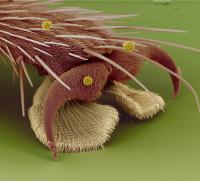
Electron microscope image of a fly footEver wondered how flies are able to walk on the ceiling without falling off? Scientists at the Max Planck Institute in Stuttgart (Germany) are investigating this James Bond-style ability of insects to hang upside down from a ceiling. In the future such knowledge could lead to the design of tiny machines that mimic this phenomenon of nature.
| Full story | 0 Comments | 5448 views |

| Environment | April 5, 2006 04:05 PM |
As long-lived predators at the top of the marine food chain, albatrosses accumulate toxic contaminants such as PCBs, DDT, and mercury in their bodies. A new study has found dramatic differences in contaminant levels between two closely related albatross species that forage in different areas of the North Pacific. Researchers also found that levels of PCBs and DDT have increased in both species over the past ten years.
| Full story | 1 Comment | 6188 views |
| Health & Medicine | April 5, 2006 02:29 PM |
Chemicals in cruciferous vegetables, such as broccoli, watercress, cabbage and cauliflower, appear to stop human prostate cancer cells from growing in mice by affecting the expression of proteins, says a University of Pittsburgh Cancer Institute study, abstract number 5601, being presented today at the annual meeting of the American Association for Cancer Research, at the Washington Convention Center in Washington, D.C.
| Full story | 0 Comments | 4725 views |
| Health & Medicine | April 5, 2006 12:05 PM |
A new study on identifying which patients were likely to have poor outcomes following a living-donor liver transplant (LDLT) found that measuring how a certain non-toxic dye was eliminated by the liver shortly after surgery was an accurate indicator of liver function, and therefore a reliable indicator of the outcome of the procedure. The study used a simple non-invasive device to measure the dye, making it particularly useful in treating transplant patients.
| Full story | 0 Comments | 4603 views |
| Biology | April 5, 2006 10:05 AM |
Salmon, like humans, require omega-3 fatty acids in their diet to function healthily. But as the fish farming industry expands, feeding salmon and other aquatic species with pellets containing fishmeal and oil derived from processing wild-caught marine fish is unsustainable in the long term. This is due to rising demands for these commodities for aquafeeds and other purposes in the face of finite or declining annual global fish catches. To provide a solution with respect to fish oil, a team of scientists from the University of British Columbia and the Department of Fisheries and Oceans, Canada, have been studying the effects of replacing anchovy oil with canola oil (also known as rapeseed oil) in the diets of salmon.
| Full story | 0 Comments | 4652 views |

- In some genetic cases of microcephaly, stem cells fail to launch
- Yale team discovers how Zika virus causes fetal brain damage
- Scientists uncover the way a common cell enzyme alerts the body to invading bacteria
- Arctic gives clues on worst mass extinction of life
- Calcium channel blockers caught in the act at atomic level
Search Bio News Net
Free Biology Newsletter
- Flexibility That A.C.A. Lent to Work Force Is Threatened by...International Herald Tribune
- Bacteria Behind Legionnaires’ Disease Found at New York Police StationInternational Herald Tribune
- Prescription Price Crisis? 28 Million Americans See Spike in Drug...MSNBC.com: Health
- Seizing on Opioid Crisis, a Drug Maker Lobbies Hard for...International Herald Tribune
- Republicans are taking a big political risk on health careAP Health News
- Why We're So Divided Over Saving WolvesNational Geographic News