


Infection with human papillomavirus (HPV) types called beta HPVs may be associated with an increased risk of developing a major type of skin cancer known as squamous cell carcinoma (SCC), according to a new study in the March 15 issue of the Journal of the National Cancer Institute. In addition, the presence of antibodies to multiple types of HPV was associated with the highest risk of SCC, but the association had limited statistical precision.

| Biology | March 14, 2006 09:32 PM |
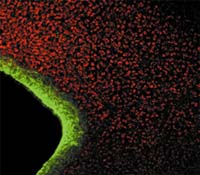
Magnified view of a leaf where leafworms have been feeding. The green colouring indicates calcium-ion influx. Image: Simone Bossi, University of Turin This "electrical black out" drastically reduces the ability of the plant's cells to react and protect themselves against getting eaten by the leafworm. The scientists are now trying to determine the identity, origins, and functioning of every substance responsible for these electrical changes (Plant Physiology, March 13, 2006).
| Full story | 0 Comments | 5465 views |

| Environment | March 14, 2006 08:32 PM |
The major players in the cruise industry, including cruise lines, local governments and shore operators – in collaboration with civil society organizations - are taking proactive measures to ensure a sustainable future for cruise tourism while preserving cruise destinations, according to a new report titled From Ship to Shore: Sustainable Stewardship in Cruise Destinations issued by Conservation International's (CI) Center for Environmental Leadership in Business (CELB).
| Full story | 0 Comments | 4690 views |

| AIDS & HIV | March 14, 2006 07:31 PM |
A new study by Rebecca Baggaley, Neil Ferguson, and Geoff Garnett (of Imperial College London) suggests that the HIV epidemic in poor countries will not be controlled through antiretroviral drugs alone, even if universal access is achieved. As they demonstrate in an article in the open-access international medical journal PLoS Medicine, without additional prevention methods such as counseling patients and their communities about safe sex, access to drugs is likely to increase HIV/AIDS prevalence.
| Full story | 0 Comments | 4950 views |
| AIDS & HIV | March 14, 2006 06:31 PM |
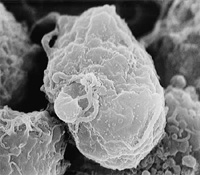
HIV infected lymphocyte (Photo: Asquith, et al) HIV attacks the immune system by infecting and killing helper T lymphocytes (also called CD4 T cells), the white blood cells responsible for mobilizing the mediators of an immune response. It's thought that the response of another type of T cell--the cytotoxic T lymphocyte (CTL)--may be responsible for a large proportion of these deaths because CTLs recognize and kill infected cells. Based on this assumption, current HIV vaccine strategies are focusing on the CTL response. But it has proven difficult to study how much ultimate control the CTL response exerts over the virus in humans.
| Full story | 0 Comments | 5364 views |

| Health & Medicine | March 14, 2006 04:05 PM |
A study presented today at the American College of Cardiology's 55th Annual Scientific Session demonstrates, for the first time, that very intensive cholesterol lowering with a statin drug can regress (partially reverse) the buildup of plaque in the coronary arteries.
| Full story | 0 Comments | 6709 views |

| Stem Cell Research | March 14, 2006 02:05 PM |
Stem cell transplantation is among one of the most exciting and hotly debated areas of medical research today. While the promise of personalized medicine and effective treatments for debilitating diseases drive progress in this area, moral and ethical dilemmas about embryonic cells continues to cloud the field. In research presented today at the American College of Cardiology's 55th Annual Scientific Session, scientists continue to explore mature stem cell sources for potentially significant cardiovascular benefits. ACC.06 is the premier cardiovascular medical meeting, bringing together over 30,000 cardiologists to further breakthroughs in cardiovascular medicine.
| Full story | 0 Comments | 5214 views |
| Health & Medicine | March 14, 2006 12:05 PM |
The flu is bad enough for healthy people, but the disease can place a special burden on those with weakened immune systems, such as patients on chemotherapy. A five-year, $10.7 million federal grant to The Children's Hospital of Philadelphia will support research to determine how adults and children with impaired immune systems may be uniquely vulnerable to influenza, and will seek better ways to protect them.
| Full story | 0 Comments | 4538 views |
| Biology | March 14, 2006 10:04 AM |
In the first study to link social evolution to climate change, Cornell University entomologists show that the social behavior of many species of sweat bees evolved simultaneously during a period of global warming.
| Full story | 0 Comments | 7048 views |

- In some genetic cases of microcephaly, stem cells fail to launch
- Yale team discovers how Zika virus causes fetal brain damage
- Scientists uncover the way a common cell enzyme alerts the body to invading bacteria
- Arctic gives clues on worst mass extinction of life
- Calcium channel blockers caught in the act at atomic level
Search Bio News Net
Free Biology Newsletter
- Flexibility That A.C.A. Lent to Work Force Is Threatened by...International Herald Tribune
- Bacteria Behind Legionnaires’ Disease Found at New York Police StationInternational Herald Tribune
- Prescription Price Crisis? 28 Million Americans See Spike in Drug...MSNBC.com: Health
- Seizing on Opioid Crisis, a Drug Maker Lobbies Hard for...International Herald Tribune
- Republicans are taking a big political risk on health careAP Health News
- Why We're So Divided Over Saving WolvesNational Geographic News