

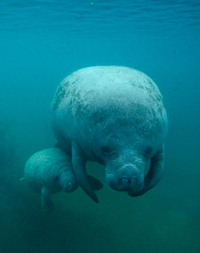
 According to statistics released in January 2006, the year 2005 was the second deadliest on record for Florida's endangered manatee population. One of the leading causes of fatalities was the toxins produced by "red tide" blooms of the alga Karenia brevis, which appear to be growing increasingly common in Florida. A recently completed collaborative study now suggests a surprisingly tight connection between the effects of the toxins on manatees and on humans, and potential implications for human impacts.

| Environment | February 26, 2006 06:55 PM |
| Full story | 1 Comment | 29101 views |

| Microarray | February 26, 2006 06:31 PM |
UCSF and Cleveland Clinic scientists have discovered a new virus in human prostate tumors. The type of virus, closely related to viruses typically found in mice, has never been detected in humans. The virus's link to human disease is still unclear, and more study is needed to determine the relationship between the virus and cancer, if any, the scientists say.
| Full story | 0 Comments | 14873 views |

| Molecular & Cell Biology | February 26, 2006 06:30 PM |
Drawing on lab experiments and computer studies, Johns Hopkins researchers have learned how a common protein delivers its warning message to cells when an infectious agent invades the body. The findings are important because this biological intruder alarm causes the body's immune system to leap into action to fight the infection. Learning more about how this process works, the researchers said, could lead to better treatments for diseases that occur when the immune system overreacts or pays too little attention to the infection alarm.
| Full story | 0 Comments | 7455 views |
| Molecular & Cell Biology | February 26, 2006 06:30 PM |
Discoveries made during the first large-scale analysis of interactions between proteins in our cells hold promise for identifying new genes involved in genetic diseases, according to researchers at Johns Hopkins and the Institute of Bioinformatics (IOB) in Bangalore.
| Full story | 0 Comments | 7040 views |

| General | February 26, 2006 06:30 PM |
As of 2006 more than 130 environmental journals from the scientific publisher Springer will be part of the initiative Online Access to Research in the Environment (OARE), a digital library for developing countries. Public and non-profit institutions in underdeveloped nations in Africa, Asia, Latin America, the Caribbean and Eastern Europe will have free access to the peer-reviewed scientific literature of Springer and other leading international publishing houses.
| Full story | 0 Comments | 12591 views |

- In some genetic cases of microcephaly, stem cells fail to launch
- Yale team discovers how Zika virus causes fetal brain damage
- Scientists uncover the way a common cell enzyme alerts the body to invading bacteria
- Arctic gives clues on worst mass extinction of life
- Calcium channel blockers caught in the act at atomic level
Search Bio News Net
Free Biology Newsletter
- Flexibility That A.C.A. Lent to Work Force Is Threatened by...International Herald Tribune
- Bacteria Behind Legionnaires’ Disease Found at New York Police StationInternational Herald Tribune
- Prescription Price Crisis? 28 Million Americans See Spike in Drug...MSNBC.com: Health
- Seizing on Opioid Crisis, a Drug Maker Lobbies Hard for...International Herald Tribune
- Republicans are taking a big political risk on health careAP Health News
- Why We're So Divided Over Saving WolvesNational Geographic News