

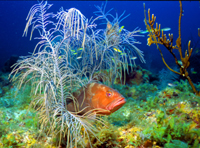
A red grouper pauses on the seabed of Dry Tortugas National Park, Florida, surrounded by gorgonian soft coral, sponges, and algae. (Photo by UM Rosenstiel School Associate Scientist Jiangang Luo.)Rosenstiel School fisheries researchers will embark on state-of-the-art research at the end of February to track black and red grouper in the Dry Tortugas National Park to develop a better understanding of species' movement and habitat requirements, so they can help more efficiently design and assess future marine-protected areas. Through funding from the National Park Service and transportation support from Yankee Fleet Ferry Service, scientists will be able to conduct this high-tech observation that involves surgically implanted transmitters for approximately a year.

| Biology | February 23, 2006 11:56 PM |
| Full story | 0 Comments | 6584 views |

| Stem Cell Research | February 23, 2006 11:45 PM |
In a giant step towards understanding prostate disease, Melbourne scientists have grown a human prostate from embryonic stem cells.
| Full story | 0 Comments | 8323 views |

| Microbiology | February 23, 2006 11:14 PM |
Bacteria could help transform a key component of disposable cups, plates and utensils into a useful eco-friendly plastic, significantly reducing the environmental impact of this ubiquitous, but difficult-to-recycle waste stream, according to a study scheduled to appear in the April 1 issue of the American Chemical Society journal, Environmental Science & Technology.
| Full story | 0 Comments | 12332 views |
| Biology | February 23, 2006 10:15 PM |
Scientists at Carnegie Mellon University have discovered that our ears use the most efficient way to process the sounds we hear, from babbling brooks to wailing babies. These results represent a significant advance in our understanding of how sound is encoded for transmission to the brain, according to the authors, whose work is published with an accompanying "News and Views" editorial in the Feb. 23 issue of Nature.
| Full story | 0 Comments | 6713 views |

| Molecular & Cell Biology | February 23, 2006 09:15 PM |
In the March issue of Trends in Biotechnology, scientists and doctors with the Physicians Committee for Responsible Medicine (PCRM) recommend using only animal serum-free media to grow live cells in the laboratory. At issue is the use of fetal calf serum, which is obtained by puncturing the heart of a fetal calf without anesthesia. Recent breakthroughs permit the growth of human cells in a medium free of animal serum, enabling scientists and researchers to make cell culture safer and more humane.
| Full story | 0 Comments | 5405 views |
| Microbiology | February 23, 2006 09:15 PM |
Bacteria are bad. Mothers and doctors, not to mention the cleaning product industry, repeatedly warn of their dangers. But a Stanford University School of Medicine microbiologist is raising the intriguing idea that persistent bacterial and viral infections have benefits.
| Full story | 0 Comments | 4949 views |

| Environment | February 23, 2006 06:56 PM |
One of the greatest challenges facing marine ecologists today is finding innovative ways to reverse the rapid decline of coral reef ecosystems around the world. Ten percent of the planet's reefs already have been degraded beyond recovery, according to one survey, and another 60 percent could die by 2050, primarily because of human activities, such as pollution, overfishing and climate change.
| Full story | 0 Comments | 5156 views |
| Biology | February 23, 2006 06:55 PM |
If mastering flight is your goal, you can't do better than to emulate a dragonfly. With four wings instead of the standard two and an unusual pitching stroke that allows the bug to hover and even shift into reverse, the slender, elegant insect is a marvel of engineering.
| Full story | 0 Comments | 6032 views |

- In some genetic cases of microcephaly, stem cells fail to launch
- Yale team discovers how Zika virus causes fetal brain damage
- Scientists uncover the way a common cell enzyme alerts the body to invading bacteria
- Arctic gives clues on worst mass extinction of life
- Calcium channel blockers caught in the act at atomic level
Search Bio News Net
Free Biology Newsletter
- Flexibility That A.C.A. Lent to Work Force Is Threatened by...International Herald Tribune
- Bacteria Behind Legionnaires’ Disease Found at New York Police StationInternational Herald Tribune
- Prescription Price Crisis? 28 Million Americans See Spike in Drug...MSNBC.com: Health
- Seizing on Opioid Crisis, a Drug Maker Lobbies Hard for...International Herald Tribune
- Republicans are taking a big political risk on health careAP Health News
- Why We're So Divided Over Saving WolvesNational Geographic News