

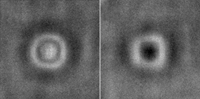
On the left, a microlens is in the 'on' state and ready to detect. The right shows the microlens in the 'off' state after it has detected its target chemical.Scientists at Georgia Tech have created technology capable of detecting trace amounts of biological or chemical agents in a matter of seconds, much faster than traditional methods, which can take hours or up to a day. The system uses reusable hydrogel microlenses so small that millions of them can fit on a one-inch-square plate. It could greatly enhance the ability of authorities responding to a biological or chemical weapons attack as well as increase the speed of medical testing. The research appears as an early view online for the chemistry journal Angawandte Chemie.

| Biotechnology | February 13, 2006 09:42 PM |
| Full story | 0 Comments | 6605 views |

| Biology | February 13, 2006 09:42 PM |
"The wild geese and every species of water fowl darkened the surface of every bay … in flocks of millions…. When disturbed, they arose to fly. The sound of their wings was like that of distant thunder."
--George Yount, California pioneer, at San Francisco Bay in 1833
| Full story | 0 Comments | 5948 views |
| Biology | February 13, 2006 09:42 PM |
Very thin but hardy, unblemished skin and slow developing gills appear to be keys to survival for newly hatched Antarctic notothenioids, a group of fish whose adults thrive in icy waters because of antifreeze proteins (AFPs) in their blood.
| Full story | 0 Comments | 6029 views |
| Biology | February 13, 2006 09:42 PM |
Assertive and even aggressive human behavior could explain why shark attacks worldwide dipped last year, continuing a five-year downward trend in close encounters with the oceanic predators, new University of Florida research suggests.
| Full story | 0 Comments | 5804 views |

| Health & Medicine | February 13, 2006 09:41 PM |
Every year, East Coast fever destroys the small farmer's dream of escaping poverty in Africa. Killing more than a million cattle and costing some $200 million annually, this tick-borne disease rages across a dozen countries in eastern and central Africa. Now, an international team of scientists has taken the first major step toward a vaccine to prevent East Coast fever. Their work, published in the February 13-17 early online edition of the Proceedings of the National Academy of Sciences, shows how genomics can generate pivotal new vaccines.
| Full story | 0 Comments | 4885 views |

| Stem Cell Research | February 13, 2006 08:42 PM |
In a significant advance for regenerative medicine, researchers at Rice University have discovered a new way to culture adult stem cells from bone marrow such that the cells themselves produce a growth matrix that is rich in important biochemical growth factors.
| Full story | 0 Comments | 5469 views |
| Health & Medicine | February 13, 2006 08:42 PM |
Cancer researcher Professor Axel Ullrich, a director at the Max Planck Institute of Biochemistry in Martinsried, Germany, already showed at the beginning of the 1990s that blocking blood vessel development in a tumour slows down its growth, and shrinks its tissue. This fundamental principle led to the development of SUTENT®, whose active ingredient is Sunitinib. SUTENT® was recently approved for clinical use in the United States, and it is expected to be brought onto the German market this year.
| Full story | 0 Comments | 5646 views |
| Stem Cell Research | February 13, 2006 07:42 PM |
Researchers at the University of Minnesota Medical School have discovered a new population of cells in human umbilical cord blood that have properties of primitive stem cells.
| Full story | 0 Comments | 8305 views |

- In some genetic cases of microcephaly, stem cells fail to launch
- Yale team discovers how Zika virus causes fetal brain damage
- Scientists uncover the way a common cell enzyme alerts the body to invading bacteria
- Arctic gives clues on worst mass extinction of life
- Calcium channel blockers caught in the act at atomic level
Search Bio News Net
Free Biology Newsletter
- Flexibility That A.C.A. Lent to Work Force Is Threatened by...International Herald Tribune
- Bacteria Behind Legionnaires’ Disease Found at New York Police StationInternational Herald Tribune
- Prescription Price Crisis? 28 Million Americans See Spike in Drug...MSNBC.com: Health
- Seizing on Opioid Crisis, a Drug Maker Lobbies Hard for...International Herald Tribune
- Republicans are taking a big political risk on health careAP Health News
- Why We're So Divided Over Saving WolvesNational Geographic News