

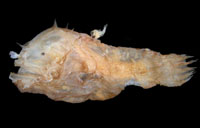
A 6.2 mm long male Photocorynus spiniceps, fused to the middle of the back of a 46 mm long female, is the world's smallest known, sexually mature vertebrate. Credit: T.W. Pietsch/University of Washington The authors of a paper in this week's Proceedings of the Royal Society of London Section B, who say their 7.9 mm-long fish from a peat swamp in Southeast Asia is the smallest fish and vertebrate known, have failed to make note of work published last fall that describes sexually mature, male anglerfishes measuring 6.2 mm to 7.4 mm in length.

| Biology | January 30, 2006 11:32 AM |
| Full story | 0 Comments | 9455 views |

| Microbiology | January 30, 2006 11:32 AM |
There is a lot of good advice to help us avoid becoming obese, such as "Eat less," and "Exercise." But here's a new and surprising piece of advice based on a promising area of obesity research: "Wash your hands."
| Full story | 0 Comments | 11398 views |

| Stem Cell Research | January 30, 2006 11:32 AM |
Damage to articular cartilage (cartilage covering the ends of bones where they meet in a joint) frequently occurs due to injury or illness, and can lead to degenerative disease. Treatments and experimental approaches to repair this articular cartilage have achieved limited results, but currently there is no method to fully restore this type of injured cartilage. Tissue engineering involving the delivery of therapeutic proteins to the injured site is a promising new approach to repairing articular cartilage.
| Full story | 0 Comments | 7576 views |
| Stem Cell Research | January 30, 2006 11:32 AM |
Scientists at the University of York have launched a new research project which aims to develop ways of making bones from blood.
| Full story | 0 Comments | 7349 views |

| Molecular & Cell Biology | January 30, 2006 11:32 AM |
Mount Sinai School of Medicine researchers have identified the precursors of cells in the skin that are part of the first line of defense against invading pathogens. The study will appear on Nature Immunology's website this week and will be published in a future issue.
| Full story | 0 Comments | 5922 views |

- In some genetic cases of microcephaly, stem cells fail to launch
- Yale team discovers how Zika virus causes fetal brain damage
- Scientists uncover the way a common cell enzyme alerts the body to invading bacteria
- Arctic gives clues on worst mass extinction of life
- Calcium channel blockers caught in the act at atomic level
Search Bio News Net
Free Biology Newsletter
- Flexibility That A.C.A. Lent to Work Force Is Threatened by...International Herald Tribune
- Bacteria Behind Legionnaires’ Disease Found at New York Police StationInternational Herald Tribune
- Prescription Price Crisis? 28 Million Americans See Spike in Drug...MSNBC.com: Health
- Seizing on Opioid Crisis, a Drug Maker Lobbies Hard for...International Herald Tribune
- Republicans are taking a big political risk on health careAP Health News
- Why We're So Divided Over Saving WolvesNational Geographic News