

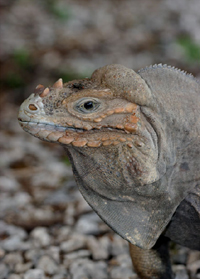
Looks can be deceiving. New gene study redraws family tree of lizards and puts primitive-looking iguanas (shown here) and relatives at the top instead of bottom of the tree." Credit line: Copyright Eladio Fernandez 2005.The most comprehensive analysis ever performed of the genetic relationships among all the major groups of snakes, lizards, and other scaly reptiles has resulted in a radical reorganization of the family tree of these animals, requiring new names for many of the tree's new branches. The research, reported in the current issue of the journal C. R. Biologies, was performed by two biologists working at Penn State University: S. Blair Hedges, professor of biology, and Nicolas Vidal, a postdoctoral fellow in Hedges' research group at the time of the research who now is a curator at the National Museum in Paris.

| Biology | November 22, 2005 11:42 PM |
| Full story | 0 Comments | 5904 views |
| Biology | November 22, 2005 11:22 PM |
In an important new study from the forthcoming Quarterly Review of Biology, biologists from Binghamton University explore the evolution of two distinct types of laughter – laughter which is stimulus-driven and laughter which is self-generated and strategic.
| Full story | 0 Comments | 5351 views |

| AIDS & HIV | November 22, 2005 11:06 PM |
Transmission of HIV, the virus that causes AIDS, from pregnant women to their infants sometime during childbirth is a huge international problem, studies have shown. Between 25 percent and 35 percent of babies born to untreated HIV-infected mothers become infected themselves.
| Full story | 0 Comments | 6686 views |

| Biotechnology | November 22, 2005 11:06 PM |
A scientific method that has been used to track the source of illegal drugs, explosives, counterfeit bills and biological warfare agents may have some new uses: detecting rapidly growing cancers and studying obesity and eating disorders.
| Full story | 0 Comments | 5652 views |

| Molecular & Cell Biology | November 22, 2005 10:52 PM |
In the neural train wreck that is stroke, the cutoff of oxygen kills brain cells through a buildup of acid, as well as by overexciting receptors on the surface of brain cells. Now, researchers exploring the detailed mechanism of this excitotoxicity and acidotoxicity have discovered how an insidious chain of molecular events contributes to its damage. In an article in the November 23, 2005, issue of Neuron, Jun Gao and colleagues say that their findings could contribute to the development of drugs to protect against the molecular "cabal" that produces such lethality.
| Full story | 0 Comments | 5471 views |
| Biotechnology | November 22, 2005 10:42 PM |
A nanoparticle commonly used in industry could have a damaging effect on plant life, according to a report by an environmental scientist at New Jersey Institute of Technology (NJIT).
| Full story | 0 Comments | 5511 views |
| Molecular & Cell Biology | November 22, 2005 10:36 PM |
Although researchers over recent years have established a foothold in understanding how p53 protects against cancer, the mechanisms by which it might contribute to aging and lifespan are not well studied. In work reported this week, researchers studying p53 function in fruit flies show new evidence that despite the protective role of p53 as a guardian against tumor formation, normal levels of p53 activity--at least in some cell types--may indeed contribute to aging and decreased lifespan.
| Full story | 0 Comments | 5109 views |
| Molecular & Cell Biology | November 22, 2005 10:25 PM |
Two proteins involved in the process that controls plant growth may help explain why human cells reject chemotherapy drugs, according to an international team of scientists.
| Full story | 0 Comments | 6530 views |

- In some genetic cases of microcephaly, stem cells fail to launch
- Yale team discovers how Zika virus causes fetal brain damage
- Scientists uncover the way a common cell enzyme alerts the body to invading bacteria
- Arctic gives clues on worst mass extinction of life
- Calcium channel blockers caught in the act at atomic level
Search Bio News Net
Free Biology Newsletter
- Flexibility That A.C.A. Lent to Work Force Is Threatened by...International Herald Tribune
- Bacteria Behind Legionnaires’ Disease Found at New York Police StationInternational Herald Tribune
- Prescription Price Crisis? 28 Million Americans See Spike in Drug...MSNBC.com: Health
- Seizing on Opioid Crisis, a Drug Maker Lobbies Hard for...International Herald Tribune
- Republicans are taking a big political risk on health careAP Health News
- Why We're So Divided Over Saving WolvesNational Geographic News